

Through thick and thin: studying together

I studied together with my partner at the FH Burgenland, in different degree programmes, but we graduated on the same day: I in the first round and he in the last. We cheered each other on from the crowd on this festive day.
My conclusion from this time studying together: it's easier to study together.
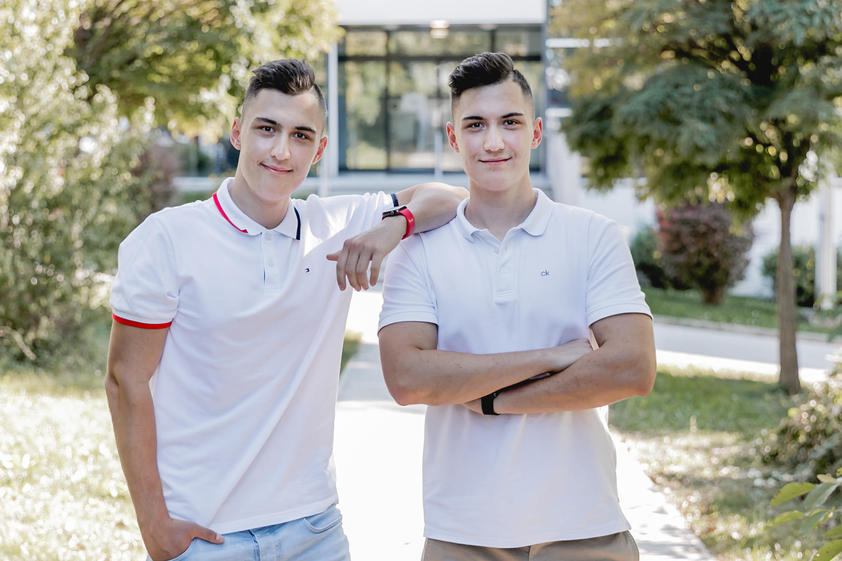
Siblings Manuel and Daniel Cserer probably thought the same thing. They are both studying part-time for a Bachelor's degree in Energy and Environmental Management. They tell us why they decided to become the do-gooders of tomorrow and why everything is easier as a duo.
Why study Energy & Environment?
In view of the extreme weather events caused by climate change and the associated existential threat to every human being, we feel it is our responsibility to expand our intellectual skills through a degree programme in order to seek and develop structural measures that can best mitigate the negative consequences of climate change.
Both are employed full-time. At the beginning of his studies, Daniel worked at the Office of the Burgenland Provincial Government. After the second semester, he moved to the Vienna Health Association. Manuel has been working as a project manager at Landesimmobilien Burgenland GmbH since the beginning of his studies.
Which of you two came up with the idea for the degree programme?
Manuel: The idea for the degree programme came from Daniel's former supervisor. He drew his attention to the possibility of a part-time degree programme at the FH Burgenland. After a few hours of research, it was clear to us that we would enrol on the Bachelor's degree programme in Energy and Environmental Management!
How can you imagine studying together as siblings? What are the advantages? What are the possible disadvantages?
While the advantages are that you can study together and always have a partner for project work, the biggest disadvantage is that we often spend longer discussing topics on which we disagree.
How has your everyday life changed as a result of your studies?
Daniel: First of all, after a day at work, I read through the various scripts on the bus home every day. Then I go to the gym and afterwards I complete work assignments from the UAS or prepare for upcoming exams.
Manuel: I also commute to work, but not by public transport, but by private car. After work, I do some physical activity, usually going for a run or to the gym. Then I sit down at my desk and "study" into the night.
Is it even possible to separate your private life from your studies when you come home after a long day of studying? Is studying often a topic at home?
Daniel: Unlike my brother, I find it very easy to separate my studies from my private life. On the one hand, I think it's good that my brother reminds me of the work that still needs to be done, but on the other hand, I have to force myself to take my well-earned afternoon off on some Sundays.
Manuel: In my opinion, it's impossible to make a clear distinction between your studies and your private life. There's always something to do at university, even if it's just a small thing, and you often think about it during the day.
Does studying together make you more understanding of your brother's situation?
Yes, by sharing the curriculum, we share the same labour-intensive times and the associated nerve-wracking phases and therefore understand each other's situation.
What was the highlight of your time at university?
The introductory event at the UAS. Everything was new, you were able to gather a lot of impressions and quickly got into conversation with a wide variety of fellow students or were able to continue chatting with them in the pub in the evening.
Does studying together bring you even closer together?
Yes, especially preparing for exams together.
What are your plans after graduation? Are you possibly planning to study for a Master's degree?
We are definitely interested in doing a Master's degree after our Bachelor's degree. We are also thinking about a PhD programme in the distant future.
A strong duo! It's impressive how sibling cohesion can carry you through your studies and lead to the energy and environmental experts of tomorrow being highly trained.
Another story is that of the Troisner-Grebien couple. Ramona studied on the Bachelor's degree programme in IT Infrastructure Management and Kerstin on the Bachelor's degree programme in International Business Relations. They got to know each other a long time before their studies and even tied the knot before they took the step towards studying together.
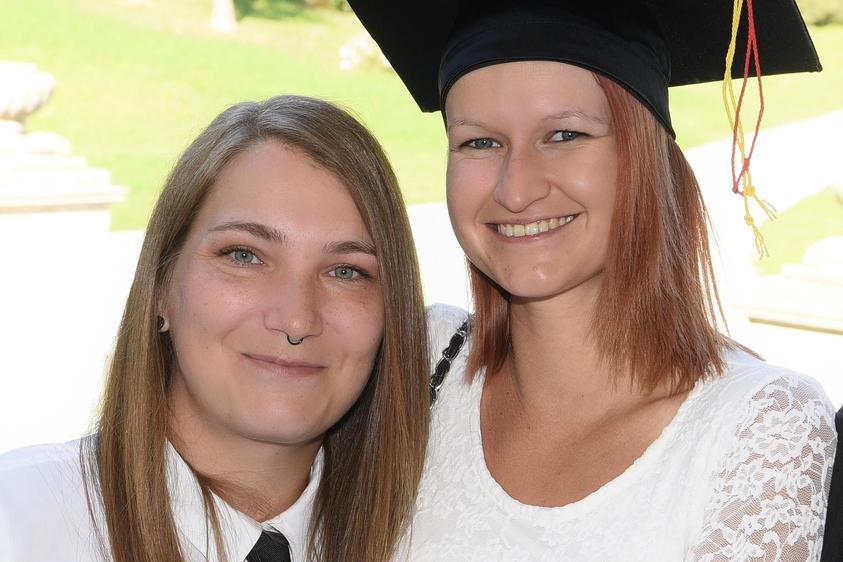
"We met before we started studying in 2013 and decided to study together. We have been a married couple since August 2017. As we chose to start our studies together, we were able to show a lot of understanding on both sides when we didn't have enough time together."
Why exactly did you choose your degree programme?
Why BIWB?
Kerstin: I chose this degree programme because it gave me the opportunity to train in the field of marketing and I was also very interested in general business administration. There was also the advantage that the degree programme has a focus on CEE countries and this was/is helpful in my professional environment - especially because of the chosen third language "Croatian".
Why BITI?
Ramona: It was important to me to choose a degree programme in which I could further my education, especially in the IT sector. Through my HTL degree in mechatronics, I already had my first contact with IT and therefore wanted to expand my knowledge in this area in particular. The content of the degree programme and the possibility of completing it while working convinced me from the outset.
How can you imagine studying together as a couple?
We both studied part-time and also worked full-time alongside our studies. While Ramona works as a software developer at a company in Wiener Neustadt, I, Kerstin, work as Head of Logistics at a concrete admixture company in Theresienfeld. As we were both very busy with our studies, there was no one-sided complaining about not having enough time or anything like that. Time management with friends, family and free time was a bit exhausting, as we were always trying to please everyone. We also had different study times, which didn't make it any easier.
How did studying together change your everyday life?
To be honest, we didn't pay that much attention to it. Of course, we met up during the breaks whenever possible to enjoy the time we had together. Coordination was very essential, especially when planning our free time. We tended to organise our study days spontaneously, but that was never a problem for the other. We were both in the same situation and were able to show a lot of understanding.
Did you motivate and support each other during your studies?
Of course we did. We were always careful to support each other as much as possible and to find words of encouragement when things weren't going so well or when things got very stressful for a short time. In our eyes, that's what makes a good partnership.
Is it even possible to separate your private life from your studies?
It wasn't important for us to separate our private lives and studies. We were always interested in listening to each other's experiences and supporting each other when necessary.
Does studying together give you more understanding for your partner's situation?
Of course there is more understanding. We usually only had one day a week to ourselves and we always used this day to get away from everyday working life and studying.
What was the highlight of your time at university?
Kerstin: My highlight was finding a small group of fellow students who supported each other in all matters, which led to friendships and made everyday life at university easier.
Ramona: My highlight was celebrating my graduation in September 2021 together with my fellow students and friends and looking back on three great years together.
What were your lessons learnt from your time studying together?
Work, studies, family, pets, everyday life & relationship are usually not so easy to juggle. But studying brings us even closer together.
How was the joint graduation ceremony in September?
It was nice to be on stage together and celebrate with our families.
Will you remain loyal to FH Burgenland?
Yes, we will remain loyal to FH Burgenland. As our tried-and-tested method of "studying together" has worked so well, we are going one better and are now doing a Master's degree at FH Burgenland at the same time. I, Kerstin, started the Master's programme in International Business Relations with a specialisation in Legal Management in September, while Ramona started the Master's programme in Business Process Engineering & Management in September.
As you can see, a degree programme can also bring married couples even closer together. Ramona and Kerstin have definitely proven their teamwork and I'm delighted to hear that they are even planning another Master's programme. If that's not ambitious! I wish you every success with your studies!
Melanie and Lukas Hanser are another brother and sister who we were able to win over for the blog and who would like to tell their story. Both studied on the Bachelor's degree programme in Social Work. They show us that you can do your "own thing" despite studying together and don't have to be dependent on your brother or sister.
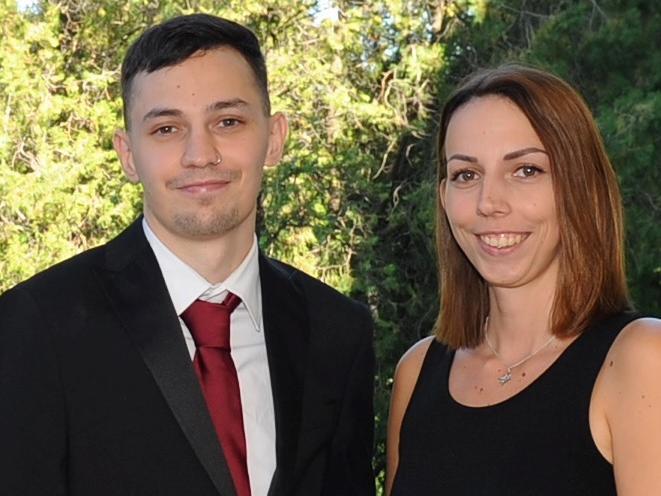
"Despite studying together, everyone can still have their own private life and that means you don't merge into one person. You can give each other tips and support each other and still build up your own circle of friends at the UAS."
Which of you two had the idea for the degree programme?
I think because I'm the older sister, I had the idea first. I was already thinking about continuing my studies after my A-levels at the age of 19, but then I gained work experience in a kindergarten first. My brother also took the "social track" before studying and that's how he came up with the idea. Perhaps we were also unconsciously influenced by the fact that our mum grew up in an SOS Children's Village and so the contact in this direction has always been there. The fact that we applied in the same year was actually more of a coincidence than an agreement.
Why exactly did you decide to study social work?
This degree programme offers a very comprehensive education that opens up many career opportunities. No other training programme in this field offers this pool of opportunities. I already decided to continue my studies during my training as a kindergarten teacher and I am particularly interested in working with families, as I also got to know this in kindergarten (child and youth welfare, crisis centre, etc.).
How can you imagine studying together as siblings? What are the advantages? What are the possible disadvantages?
On our degree programme, we were divided into two groups. My brother and I weren't in the same group, so our paths separated relatively quickly during our studies (our own circle of friends, sometimes different lecturers...). Nevertheless, we were always able to exchange information about what each other had already done/heard. Nevertheless, we never learnt together, I don't think we're the type for that. I can't think of any disadvantages.
Has your everyday life changed as a result of your studies?
Everyday life hasn't really changed. We've always gone our own way and never had the same circle of friends or much planned free time together. Coordination is only necessary when looking for an internship, but we had rather different preferences there too.
Are your studies often a topic of discussion at home?
Studying was certainly a frequent topic, we simply exchanged ideas regularly. I think that as we otherwise had less in common, it was good to have a "new" dialogue. So it didn't bother us much that it was also a topic in our private lives, because when you're studying full-time, your studies are always present anyway. Despite studying together, everyone still has their own private life, so it's still easy to switch off.
Does studying together make you more understanding of your brother/sister's situation?
I think so, you have similar experiences and similar time pressures, at least as far as studying is concerned. As I said, everyone still has their own private life.
What was the highlight of your time at university?
There were a few highlights, despite the coronavirus crisis and lockdown. Before the coronavirus pandemic, the trips we made to institutions and organisations to get to know them were particularly interesting. The wish punch we organised (punch stall with music etc.) to collect donations was also a small highlight. The experiential education seminar from the 5th and 6th semesters is particularly memorable, as we got together again shortly before the end of the degree programme and spent a fun weekend together.
Does studying together bring you closer together?
I think it has a positive effect, as you always have something to talk about and therefore naturally have more in common than before.
What are your plans after graduation?
I work in mobile family care and can imagine doing a Master's or Master's programme, so we'll see what the future holds. My brother has just started working in youth work/street work. I think I'll stick to my professional life for now, but never say never.
Thank you for your story, which shows that studying together doesn't necessarily mean that you automatically have to spend more time together and learn together. If you favoured your independence before, you can still do so. Certainly, both have emphasised that the mutual exchange is nevertheless stimulating.
The story of the married couple Damla and Yasin Egri is also inspiring. It is not everyday that a married couple stand on stage together at a graduation ceremony. Damla and Yasin Egri graduated together from the Bachelor's degree programme in International Business Relations last September. The joint graduation was a special and emotional moment for them. They definitely proved that good time management is needed to juggle marriage, household, leisure time and studying.
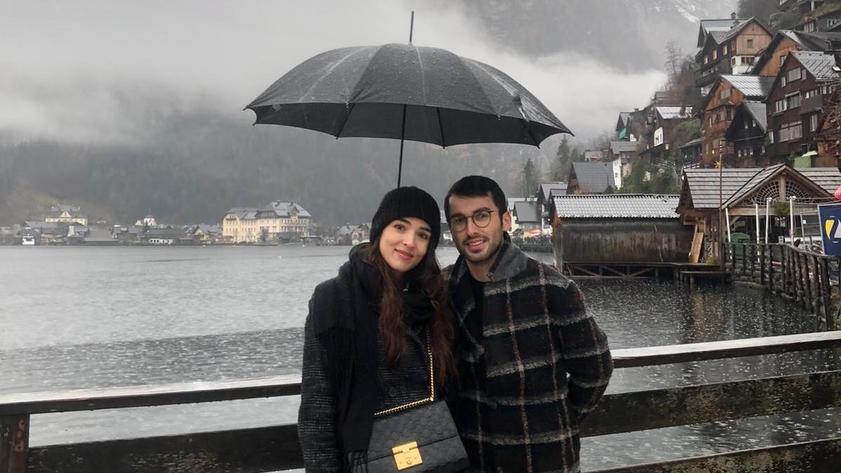
"We worked during the week and studied on Fridays and Saturdays. Housework, cooking, shopping... that was only possible during breaks. But then we decided to always dedicate Sundays to family and friends. That soon worked out."
How can you imagine studying together as a couple?
Studying alongside a full-time job was a huge challenge, but we still managed to overcome it. The changes caused by the coronavirus pandemic were both positive and negative. Because we are not just fellow students, but also a couple, we were lucky enough to always have someone to talk to. I, Yasin, can only recommend others to form fixed learning groups in distance learning, with whom you can meet and exchange ideas.
When did you decide to embark on the adventure of studying as a couple?
We made the decision to study together very spontaneously in summer 2018 and were all the more pleased to get hold of two remaining places at Burgenland UAS. We quickly realised that we would feel at home on the course. It's very personal at FH Burgenland. Wherever possible, consideration is given to the students' circumstances. We never felt like a student number.
What are your plans for the future?
We have both specialised in Controlling.
Damla: The degree was a milestone for me on my way to becoming a tax consultant at KPMG.
Yasin: The degree also opens up new opportunities for me at work, in the Kirchdorfer Group. I would like to specialise further in the area of blockchain.
We are both staying loyal to FH Burgenland and continuing our studies on the part-time Master's degree programme in International Business Relations. There was a lot of understanding and support from our employers, but also from our personal environment.
A determined couple! Thank you very much for the insights into your private and working lives and I wish you both every success in your Master's degree programme! We know from this blog post at the latest that studying in pairs is popular at Burgenland University of Applied Sciences. Be it siblings, couples, married couples or other constellations that make everyday study life more colourful and individual. One thing is certain: there are quite a few dream teams at FH Burgenland.
# Gepostet in:
Insights from students


