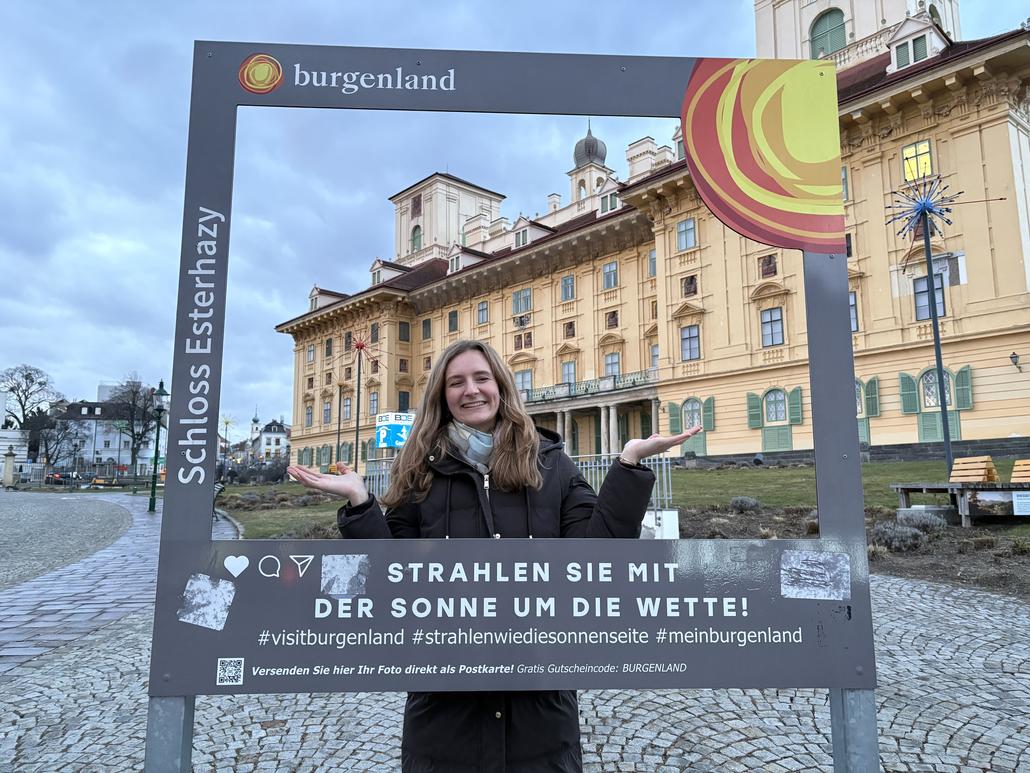
“Always turn your face towards the sun”: With a life motto like this, it seems only natural that Elisabeth Schimpf found her way to sunny Burgenland.
During her Master’s studies in Germany, she wanted to gain international experience. Discovering that she could do so at Burgenland University of Applied Sciences, without travelling to the other side of the world, proved to be a stroke of luck for the German student. She spent not only her fourth Master’s semester in Austria through Erasmus+, but also stayed to write her Master’s thesis.
After completing her Bachelor’s degree in Philosophy, Arts and Media at the University of Hildesheim, Elisabeth discovered her enthusiasm for the intersection of science and media while working as a student assistant in university communications. This prompted her to pursue a Master’s degree in Specialist Journalism and Corporate Communications at the Technical University of Applied Sciences Würzburg-Schweinfurt. “Especially in times of AI and fake news, quality journalism is becoming increasingly important.”
It doesn’t have to be on the other side of the world
While looking for a suitable partner university, Elisabeth came across the Master’s programme in Digital Media and Communication at Burgenland University of Applied Sciences. “The course content was a perfect match for my area of specialisation.” She never saw going to Austria, rather than a faraway country, as a disadvantage. “Many people think Erasmus has to take you as far away as possible. For me, Austria was exactly right.” Sharing a language made academic discussions easier, while she also met people from a wide range of countries. “You don’t just travel to another country; you meet people with completely different perspectives.” The International Office’s Welcome Week, shared excursions and life in the student residence made her stay particularly memorable.
She also gained valuable experience through her studies. She particularly appreciated the up-to-date teaching on artificial intelligence and the opportunity to explore changes in communication and journalism in depth. She was also impressed by her fellow students, who were combining their studies with professional careers. “Many already have professional experience and are incredibly committed. Their motivation is infectious, and you learn a great deal from one another.” In addition to her experience abroad, she rounded off her learning with a final internship at Bayerischer Rundfunk, Bavaria’s public service broadcaster.
One distinctive aspect of her Erasmus stay was her Master’s thesis, which was supervised jointly by two universities and benefited from their different academic perspectives. In it, she compares science communication by public service media in Germany and Austria. The result is a practical guide that helps universities present scientific topics in an accessible way, tailored to the needs of the media. She also explores how social media can serve as a starting point for sparking interest in scientific subjects. “Research must not remain in an ivory tower. Science needs to be communicated clearly so that it can reach a wide audience.”