

Research for the Master's thesis


Shopping behaviour of wheelchair users
In summer 2018, Thomas Kremsner completed his Master's degree in International Business Relations with a focus on Marketing & Consumer Insight with distinction. He dedicated his Master's thesis to a special topic. He used an eye-tracking camera to investigate the shopping behaviour of wheelchair users. He has already presented his findings at an international conference. A publication is also planned.
Orientation is often a major problem for people with limited mobility when shopping.
Nine wheelchair users and eleven people without mobility impairments made themselves available for the tests. The results of people with and without wheelchairs were compared and the similarities and differences were analysed.
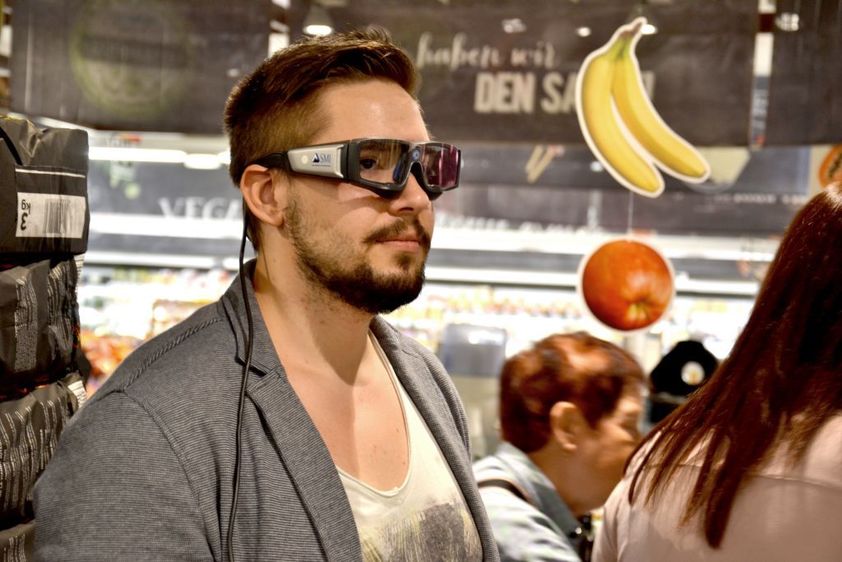
‘In shopping centres, products at eye level usually get the most attention. For wheelchair users, however, it always depends on the degree of mobility impairment and other factors such as the shop layout,’ explains Thomas.
Basically, it was observed how long wheelchair users need to find a certain product in the shop, which areas are clearly visible and which are less so. An eye-tracking camera recorded the eye movements of the test subjects. ‘At Burgenland University of Applied Sciences, an entire research lab is dedicated to the topic of eye tracking. It was always exciting for me to work in this area.’
Thomas Kremsner remains committed to research. He has been working as a research assistant at Forschung Burgenland for several months now.
Making health promotion measurable
In hospitals, the focus is on the medical diagnosis and treatment of patients. The importance of health promotion in this setting is increasing. Many hospitals in Austria are already focussing on improving people's health in addition to providing medical care.
However, strategic integration into the organisation is lacking in most hospitals. For this reason, FH Burgenland graduate Martina Meister has now adapted an evaluation concept developed at the end of the 1990s, the Balanced Scorecard (BSC), to meet current needs. She was honoured with the Health Research Award 2018 for her Master's thesis from the Integrated Care Management Master's degree programme on the topic of ‘Development of a “Health Balanced Scorecard” for the hospital setting under the aspect of integrated care’.
Martina explains her approach in a YouTube video.
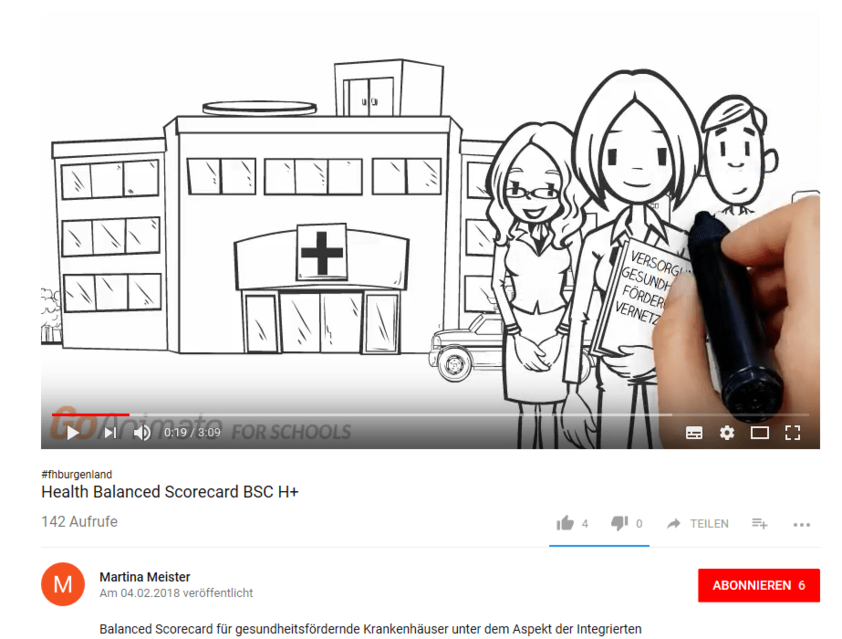
Health-Balacens Scorecard
Nataniel Zemla, PhD graduate of the FH Burgenland
‘Health promotion and prevention are becoming increasingly important in the Austrian healthcare system. Ultimately, everyone benefits from increased health awareness - from hospital staff to patients and the population as a whole.’
Conventional evaluation concepts soon reach their limits here. ‘I asked myself the question: How can a ‘Health-Balanced Scorecard’ be presented for the hospital setting from the aspect of integrated care?
The future of energy suppliers
In December 2012, the Energy Efficiency Directive 2012/27/EU (EED) was adopted as the most important piece of EU legislation on energy efficiency to date. This directive created a common European framework for energy efficiency in order to achieve the overarching EU energy efficiency target of 20 % by 2020. Alexandra Kobzev, a graduate of the Energy and Environmental Management Master's programme at Burgenland University of Applied Sciences, dedicated her Master's thesis to the effects of this EU directive on energy supply companies. She surveyed Austrian and German energy supply companies and came to a differentiated conclusion.
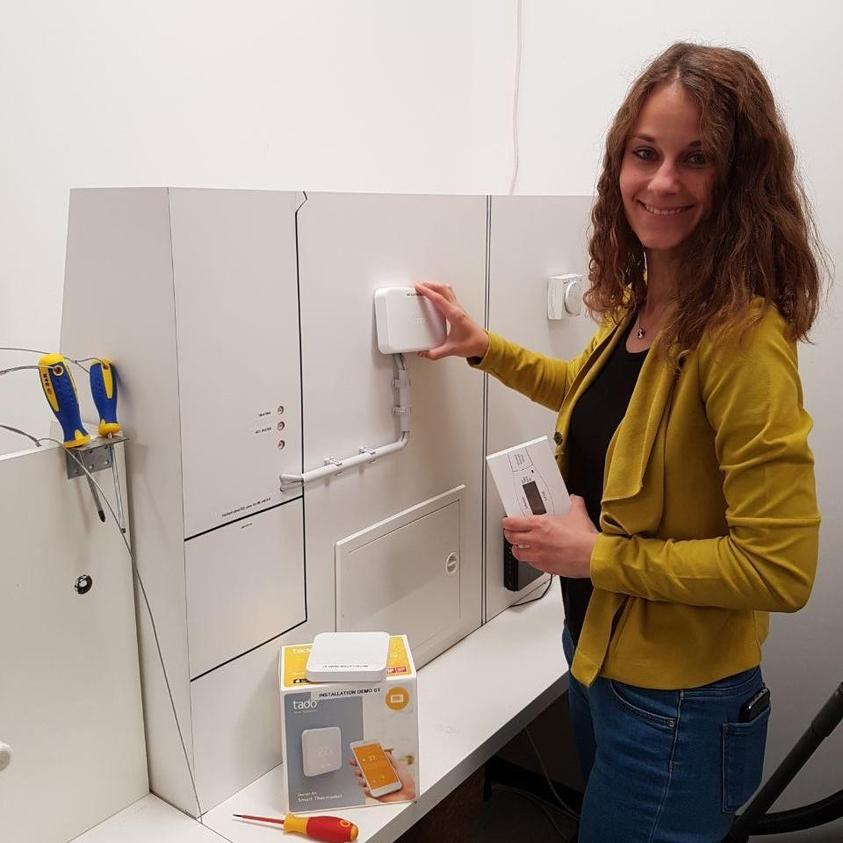
‘In my final thesis, I wanted to analyse the effect of the EED on the energy supply companies and find out what potential and risks it entails,’ explains Alexandra. Following extensive literature research, the graduate conducted six expert interviews with two Austrian regional energy supply companies, including Energie Burgenland, and four German municipal utilities. ‘Risks from the EED arise for the energy supply companies due to the constant change in the legal situation,’ she notes. ’Some energy supply companies are already pursuing ambitious corporate goals in order to remain competitive. Whereas others are still waiting to see how the market develops and how the EED is tightened up.’
Research for clients
The collaboration between UAS Burgenland graduate Norbert Fesel and EuroCloud Austria was a success for both sides. Norbert successfully completed his Master's degree in Cloud Computing Engineering in July. In his master's thesis, he dealt with important issues relating to cloud service certifications. ‘I worked on the EuroCloud StarAudit certification framework and developed proposals for its expansion,’ explains the dedicated young expert.
‘Mr Fesel's work is characterised by a solid theoretical foundation without losing the explicit, concrete applicability of its results. Because a really important quality feature of the work is that the research results were delivered in a directly realisable way,’ praises his supervisor Tobias Höllwarth, Spokesman of the Board of EuroCloud Austria. It often happens that research questions are put directly to students by companies.
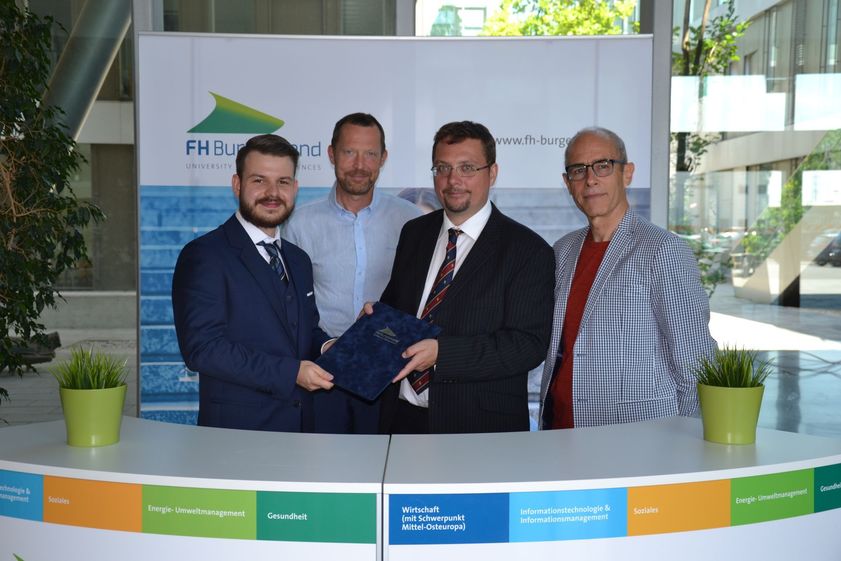
Norbert's work dealt with the justification of the importance of cloud service certifications (for cloud auditors and cloud brokers) and reviewed the cloud service certification ‘EuroCloud StarAudit’ for its completeness of content and future viability by comparing current and future requirement categories (derived from literature and a trend analysis) with the requirements of a five-star rating of the EuroCloud Star Audit. Recommendations were formulated based on the results of these reviews.
# Gepostet in:
Insights from students


