

European legislation: A look behind the scenes.
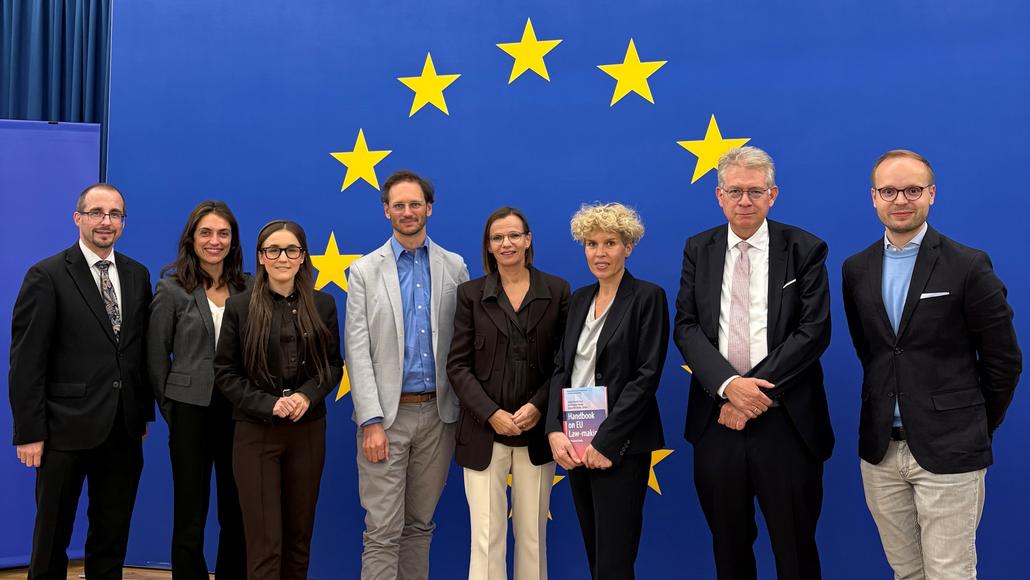
The authors present at the book launch (from left): Arnold Kammel, Nina Schilling, Marina Jovanovic, Bernhard Zeilinger, Gerda Füricht-Fiegl, Julia Kreyler-Valsky, Oliver Drewes, Martin Wagner (c) European Parliament Liaison Office in Austria
Eisenstadt/Vienna, 25 September 2026. How are directives and regulations drawn up at EU level? What informal preparatory work is required? Who shapes the decisions behind the scenes? And what does ‘Better Regulation’ mean in practice? These questions were the focus of a panel discussion followed by a book launch, attended by Oliver Drewes, Managing Partner at Panta Rhei Europe, Gerda Füricht-Fiegl, rector at the USTP / St. Pölten University of Applied Sciences, and Arnold Kammel, Secretary-General at the Federal Ministry of Defence. Opening remarks were given by Georg Pfeifer, Head of the European Parliament’s Office in Austria, and Patrick Lobis, Head of the European Commission’s Representation in Austria.
Exclusive insights into the EU
The anthology, published by Springer Nature, offers a comprehensive overview of the EU’s legislative and decision-making process. It combines academic foundations with practical insights into the work of the European institutions.
The contributions are written by academics, but above all by experienced practitioners from the EU institutions, ministries of various EU Member States and other organisations operating within the EU context. This English-language handbook examines the workings of EU legislation, the role of key players, the influence of lobbying, and selected policy areas such as digital and energy policy.
“This handbook has succeeded in supplementing the multitude of legal publications on the EU legislative process with a highly practical perspective. It is intended to help students as well as ‘Brussels newcomers’ from the worlds of politics, the media and business to better understand these processes,” emphasises Gerda Füricht-Fiegl, one of the editors.
The book is aimed at interested readers from universities, universities of applied sciences, the business sector, and anyone who wishes to gain a better understanding of EU decision-making processes. Each section begins with an academic overview of the current state of research and is supplemented by practical contributions from the EU institutions.
The book is available from Springer Nature .
Short biographies of the editors
Gerda Füricht-Fiegl is a political scientist and rector at USTP / St. Pölten University of Applied Sciences. Prior to this, she led the English-taught Master’s Degree Programme in European Studies – Management of EU Projects at the University of Applied Sciences Burgenland. She has many years of experience in political communication, including as an official at the European Commission and as a press spokesperson at the European Parliament.
Julia Kreyler-Valsky holds a PhD in sociology and teaches at the University of Applied Sciences Burgenland. Her research and teaching focus on anti-discrimination and labour market inclusion. Her professional experience includes roles as a press officer at the Austrian Federal Chancellery and as an attaché at the Austrian missions in New York (UN) and Paris (OECD).
Alexander Burka is a professor at the University of Applied Sciences Burgenland and co-founder and managing director of the CIVIC Institute for International Education in Düsseldorf. He has worked for numerous national and international institutions in the fields of international competencies, civil society and democratic development.
Find out more about Burgenland University of Applied Sciences at www.hochschule-burgenland.at
# Gepostet in:
News,
Presse,
Aktuelles


