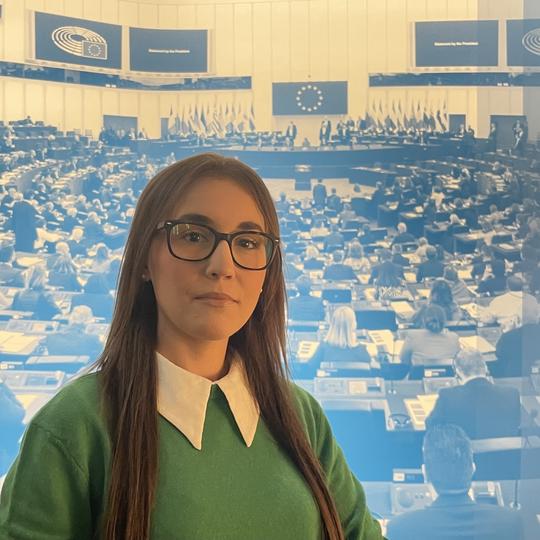
Fake news and disinformation in a political context are nothing new. Well-known examples include the 2016 US election and Brexit. Already in 2019, experts saw fake news and disinformation as a threat to the EU elections. In her Master’s thesis, Marina Jovanović, a graduate of University of Applied Sciences Burgenland (Fachhochschule Burgenland), looked at the expectations for the 2024 EU elections and the exacerbated situation due to AI.
Eisenstadt, 20 February 2024 – The topic of disinformation in a political context is a dynamically growing challenge. Marina Jovanović, an expert in international communication, addresses the specific threat that “fake news” and similar phenomena pose for the upcoming EU elections in her Master's thesis completed within the Master’s Degree Programme in European Studies - Management of EU Projects at University of Applied Sciences Burgenland.
Since 2015, Russia has been attacking Western democracies in the form of disinformation strategies, often in conjunction with cyberattacks. This also happened in the run-up to the 2019 EU elections. The attacks are aimed at weakening people’s trust in democratically elected governments and polarising them. In her Master’s thesis, Marina Jovanović examined the consequences the EU has drawn for the upcoming EU elections. Among other things, she conducted interviews with nine experts and spoke to EU officials, researchers and experts in the fields of disinformation monitoring, political communication and campaign management.
EU Action Plan and the role of the tech giants
In her Master’s thesis, Marina Jovanović explains that the officials in the EU institutions launched the East StratCom Task Force as a first step in 2015, and that the “Action Plan against Disinformation” came into force in 2018. In addition, a voluntary Code of Practice on Disinformation now defines EU standards in the fight against the threat of fake news.
Under no circumstances should the responsible persons rely on the fact that the problem will regulate itself or be resolved by the measures already in place,” warns the author of the thesis. The developments within the context of the EU’s Digital Services Act (DSA) are seen as promising. “The DSA entails that, for the first time, online platforms can be held accountable for their disinformation actions.”
What is particularly important is cooperation with companies whose platforms are used to spread disinformation. “The tech companies must understand the role they play with regard to this issue and the responsibility they have in fighting disinformation”, says Marina Jovanović. More transparency is definitely needed here.
Awareness and resilience among the population are not high enough
According to the experts interviewed, there is currently a high level of awareness of the threats posed by disinformation, at least at a political level. “The urgency has also been recognised, and there is a drive to act quickly and, if necessary, adapt existing tools to combat the threat.” However, awareness among EU citizens leaves plenty of room for improvement. Intensified efforts by the EU to raise awareness among the population are urgently needed.
What will the 2024 elections bring?
“Disinformation is a symptom of a much langer problem,” Marina Jovanović quotes one of her interviewees. There is a great danger that public opinion will be manipulated by disinformation also in the 2024 EU elections. The rapid developments in the technological sector - particularly with AI - suggest that attacks on democratic elections in 2024 will be even more sophisticated than before. The EU is currently facing this with a mix of optimism and definitely more awareness and “combat readiness” than in 2019.
Fake news – a definition of terms
The EU separates the concept of disinformation from the term “fake news”, which is frequently associated with it.
- Misinformation is false or misleading content shared without harmful intent though the effects can still be harmful, e.g. when people share false information with friends and family in good faith.
- Disinformation is false or misleading content that is spread with an intention to deceive or secure economic or political gain and which may cause public harm.
- Information influence operation refers to coordinated efforts by either domestic or foreign actors to influence a target audience using a range of deceptive means, including suppressing independent information sources in combination with disinformation.
- Foreign interference in the information space, often carried out as part of a broader hybrid operation, can be understood as coercive and deceptive efforts to disrupt the free formation and expression of individuals’ political will by a foreign state actor or its agents.
About the author
Marina Jovanović graduated from the Master’s Degree Programme in European Studies - Management of EU Projects at University of Applied Sciences Burgenland. She comes from Serbia and lives in Vienna. Here she completed a bachelor’s degree programme in Media and Communications Science, a master’s degree programme in Marketing, and a doctoral programme in Social Sciences and Communications. She gained professional experience in international organisations, including the United Nations in Vienna. She is a member of the EAPC, the European Association of Political Consultants.
Facts about the Master’s Degree Programme in European Studies - Management of EU Projects
This degree programme, which is unique in Europe, is aimed at all those who see their professional future in the field of EU policies or who would like to implement EU projects. Work opportunities range from the EU institutions to national administration, i.e. federal, provincial and local authorities, companies, universities or other institutions. Academic degree: Master of Arts in Business (MA); organisational form: part-time, usually every two weeks on Friday from 8:30 to 21:00 and Saturday from 8:30 to 19:00; number of study places: 28; study location: Eisenstadt; language of tuition: English; no tuition fees.
For more information on the degree programmes at University of Applied Sciences Burgenland, visit: www.fh-burgenland.at. Enrolment is possible until 31 May.
Further information:
Mag.a Christiane Staab
Marketing & Communication
Fachhochschule Burgenland GmbH
Tel: +43 (0)5 7705 3537
E-Mail: christiane.staab@hochschule-burgenland.at