Discover your path to success - find the perfect degree programme for your future!
Master's thesis becomes dream house
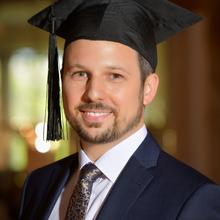
Pinkafeld, 19 May 2026 : Sustainable and energy-efficient - that's how Patrick Höfler from Pinggau wanted his dream home to be. He had been interested in heating systems since his youth and, after graduating from HTL Pinkafeld, completed a Bachelor's degree in Energy and Environmental Management and a Master's degree in Building Technology and Building Management at the Burgenland University of Applied Sciences. During his Master's degree, Patrick Höfler planned and realised a house together with his partner. At the same time, he came up with the idea of a special heating system that heats and cools the building with a combination of a geothermal heat pump, solar system, hygienic storage tank and brine storage tank. An ideal topic for his master's thesis, he thought, and put his plans into action. A monitoring system installed provided valuable data during the first year of operation, which he used for his scientific work. The joy of successfully completing his studies was accompanied by the confirmation: All the plans and calculations were correct. The dream house was a complete success.
Practical relevance felt first-hand

Sustainability has been important to me for a long time. I only want to use the energy that is necessary for the building and wanted to develop a system that is as energy-efficient as possible.
Patrick Höfler, graduate of the Burgenland University of Applied Sciences
The house was built using sustainable building materials such as clay, hemp and wood, which ensure the best insulation values and a natural indoor climate. The detached house has a heated living space of 166 m² and a heating requirement of 49.2 kWh/m²a. It is heated and cooled by a combination of geothermal heat pump and solar system, with passive natural cooling. The heat pump achieves a coefficient of performance of 7 for heating, cooling and hot water. This means that the heat pump generates or provides around 7 kWh of thermal energy from 1 kWh of electricity, which can be categorised as extremely efficient.
Annual energy consumption drastically reduced
The annual energy consumption for heating, cooling and domestic hot water utilisation using a PV system in the Höfler family home with two adults and a small child is around 2,000 kWh.
For comparison: for a detached house with approx. 160 m², the annual electricity consumption of an average family without electric heating is roughly around 3,500 to 5,000 kWh per year - i.e. twice as much. In summer, the Höfler family's hot water requirements are almost completely covered by the solar yield, and overall the optimised interaction of heat pump, solar and storage technology ensures low operating costs.
Challenges in the control technology
Everything went smoothly for the young house builder when it came to the hydraulic design. The challenge for Patrick Höfler was the control technology. Everything in the house runs automatically, such as switching between cooling in summer and heating in winter, as well as preheating and regenerating the geothermal energy from the solar system. These adjustments were more time-consuming than expected, but could be carried out without any problems. Patrick Höfler now works as a project manager in an installation company. The expertise he acquired during his studies and through building houses is in great demand from his customers - from companies to house builders.
Facts about the degree programme
Master's programme - 4 semesters; Academic degree: Graduate engineer for technical-scientific professions - Dipl.Ing.; Organisational form: part-time with lessons at the study centre on average every fortnight: usually Friday 14:00 to 21:45 and Saturday from 8:30 to approx. 18:30, plus two attendance blocks per semester Thursday to Saturday from 08:30 to approx. 18:45; Study places: 30; Study location: 7423 Pinkafeld, Steinamangerstraße 21; Language: German (required language level min. B2)/English (required language level min. B2); Tuition fees: none
Leading expertise: As a pioneer of building technology training in Austria, the Burgenland University of Applied Sciences has more than 30 years of experience. Potential employers are all companies and organisations in the private and public sectors that deal with the planning, construction, operation and maintenance of buildings and their technical building equipment.
Registration is possible at www.hochschule-burgenland.at until 31 May. There are still places available on the Bachelor's degree programme in Energy and Environmental Management!
Enquiry notes:
Mag.a Christiane Staab │ Marketing and Communication │ University of Applied Sciences Burgenland GmbH │ Tel: +43 (0)5 7705 3537 │ E-Mail: christiane.staab(at)hochschule-burgenland.at


