

Scientific analysis: Air travel using PtL kerosene is more climate-friendly under certain conditions
Pinkafeld, 20 October 2026. In 2025, the number of holiday trips made by Austrians by plane stood at 5.2 million (STATISTIK AUSTRIA). Air travel is also becoming increasingly common during the autumn half-term holidays. This makes it a good time to explore ways in which air travel can be made more climate-friendly. Benjamin Paul, a student on the Bachelor’s Degree Programme in Energy and Environmental Management at theUniversity of Applied Sciences Burgenland in Pinkafeld, has written his Bachelor’s thesis on the climate impact of Power-to-Liquid (PtL) aviation fuel. In it, he examined the extent to which, and under what conditions, PtL kerosene can help reduce the climate impact of air travel.
The production of PtL kerosene requires water and CO₂ as raw materials, as well as electrical energy. PtL kerosene is a synthetic aviation fuel. Unlike fossil kerosene, it does not utilise any additional fossil carbon from crude oil. The student compared various previously published studies and analysed their findings.
Lower climate impact under certain circumstances
- It is important to note that not every PtL variant is automatically climate-friendly. Depending on where the electricity comes from and the source of theCO₂, the results can vary significantly. PtL kerosene is therefore not a one-size-fits-all solution.
- Variants that use renewable electricity andCO₂ captured from the air perform particularly well. This combination achieves the lowest emission levels.
CO₂ is not the only problem with flying
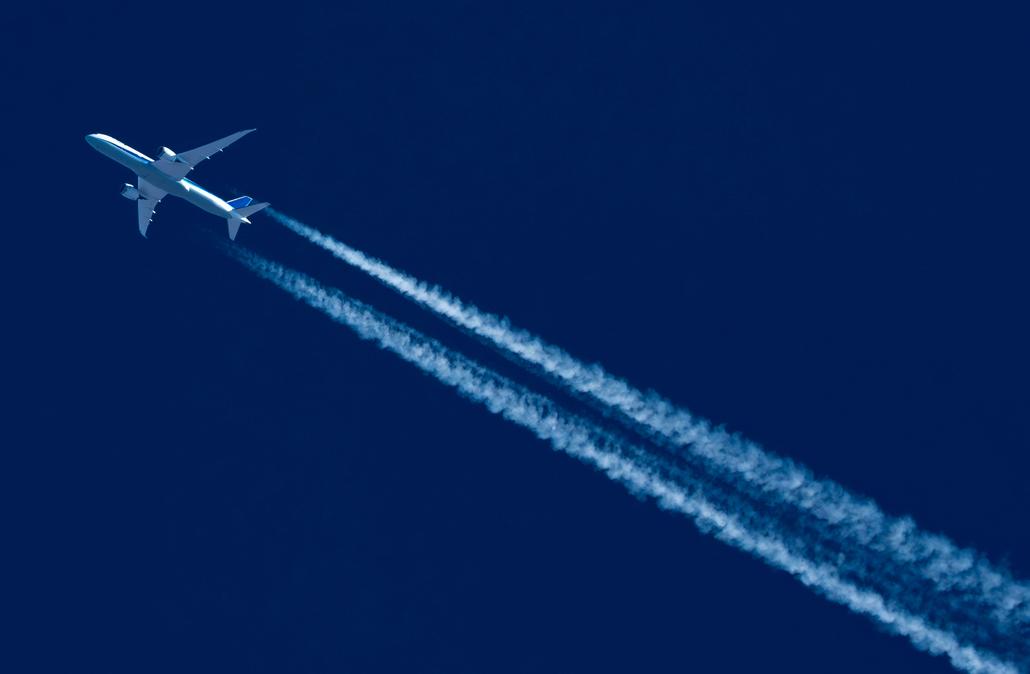
- In his thesis, the student also took into account that air travel not only emitsCO₂, but also causes other climate-damaging effects, such as contrails, soot particles or nitrogen oxides. These so-called non-CO₂ effects account for the majority of the overall negative climate impact.
- In this context, PtL kerosene represents a promising alternative, partly due to reduced soot formation and the associated formation of contrail cirrus (artificial ice clouds formed from aircraft exhaust).
- The results also show that if air traffic continues to grow by 5 per cent annually, as forecast, alternative fuel alone will not be sufficient to meet climate targets.
PtL kerosene can make an important contribution, but it is only one building block on the path to more climate-friendly flying.
Information about the degree programme
The Bachelor’s Degree Programme in Energy and Environmental Management can be undertaken as a 6-semester full-time programme (Tuesday to Friday) or as a part-time programme alongside work (every two weeks: half-day on Friday, full day on Saturday) or as an extended part-time programme (extended to eight semesters, resulting in a lower semester workload). Students graduate with the academic degree ‘Bachelor of Science in Engineering, BSc’. The campus in Pinkafeld is home to one of the most modern laboratories in the Austrian higher education sector and thus stands for practice-oriented education at an academic level. Entry requirements for the Bachelor’s programme are the Matura/ school finishing exams, a university entrance qualification or vocational maturity examination, or a preparatory course with an additional qualification examination. As with all degree programmes at the University of Applied Sciences Burgenland, no tuition fees are charged.
Please note: Applications for all degree programmes at the University of Applied Sciences Burgenland are already open for the 2027/28 academic year. The application deadline is 31 March for all Bachelor’s programmes and 31 May for all Master’s programmes. Find out more at www.hochschule-burgenland.at
# Gepostet in:
News,
Presse,
Aktuelles


