

Wood products and timber structures should be designed to be durable, repairable, dismantlable and, as far as possible, made from a single type of timber.
Peter Gabriel, graduate of the Master’s programme in Energy and Environmental Management
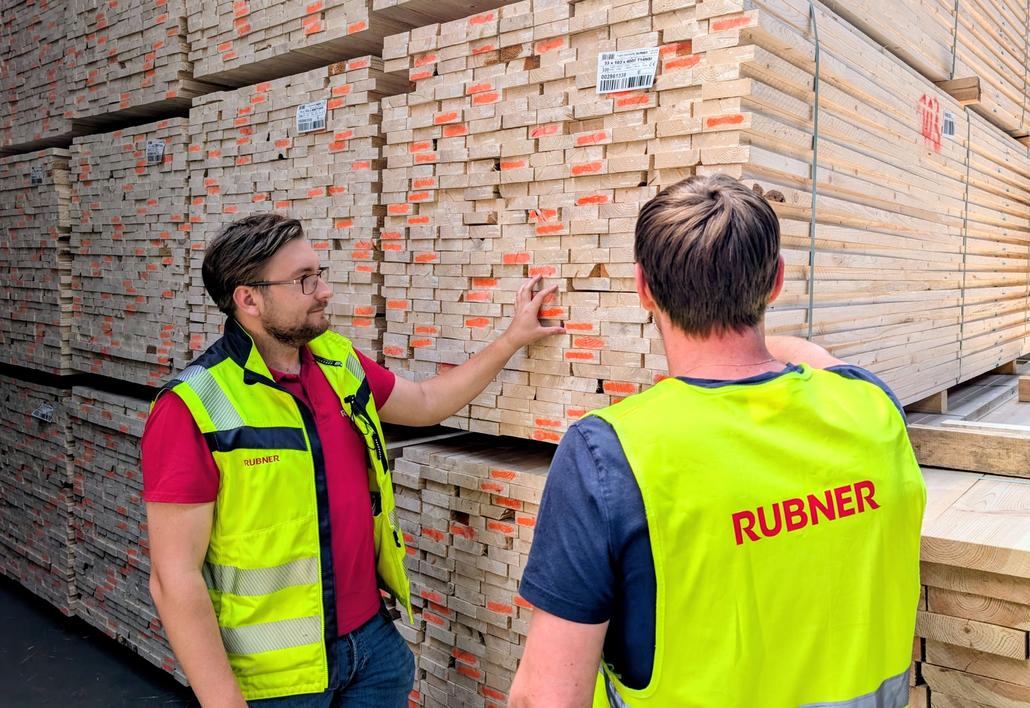
Mit Kreislaufwirtschaft in der Holzindustrie beschäftigte sich Absolvent Peter Gabriel. Foto (c)Rubner
Pinkafeld, 14 July 2026. The good news is: Peter Gabriel’s Master’s thesis essentially concludes that the timber industry in Austria is already on the right track, but that a genuine circular economy requires even greater transparency, standardised key performance indicators and more systematically documented measures. For his thesis, the graduate of the Master’s programme in Energy and Environmental Management at Burgenland University of Applied Sciences analysed the sustainability reports of four Austrian companies in the timber industry.
“The circular economy is regarded as a key concept for the future of a more sustainable timber industry,” he explains. “It aims to keep timber in the cycle of use for as long as possible, to reuse materials multiple times and to avoid waste as much as possible.” He himself is the sustainability and marketing officer at the Rubner Holzindustrie Group, one of Europe’s leading timber engineering companies, based in South Tyrol. The four sustainability reports he analysed for his study reveal: “Whilst the companies do report on measures such as sustainable procurement, waste prevention and recycling, what is often missing are standardised indicators, target values and comparable data.”
Fundamentally, however, the timber industry is on the right track. The research shows that the circular economy in the timber industry is far more than just recycling. Ideally, it begins as early as the product design stage.
Wood products and timber structures should be designed to be durable, repairable, dismantlable and, as far as possible, made from a single type of timber.
Peter Gabriel, graduate of the Master’s programme in Energy and Environmental Management
Innovative ideas such as the Digital Product Passport can help to document material composition, origin and future recycling options in a traceable manner.
One thing is particularly clear: a circular economy in the timber industry can only work if it is conceived across the entire value chain. This includes sustainable timber sourcing, the use of secondary materials, the take-back of building elements, the reuse of components and the development of new business models. “In the timber industry, therefore, a circular economy does not simply mean recycling timber at the end of its life, but designing processes, products and business models in such a way that recyclable materials remain in the cycle for as long as possible and resources are used more efficiently.”
Find out more about studying at Burgenland University of Applied Sciences and how to apply for a remaining place at www.hochschule-burgenland.at
Rückfragehinweise:
Mag.a Christiane Staab │ Marketing und Kommunikation │ Hochschule für Angewandte Wissenschaften Burgenland GmbH │ Tel: +43 (0)5 7705 3537 │ E-Mail: christiane.staab(at)hochschule-burgenland.at
# Gepostet in:
News,
Presse,
Aktuelles


