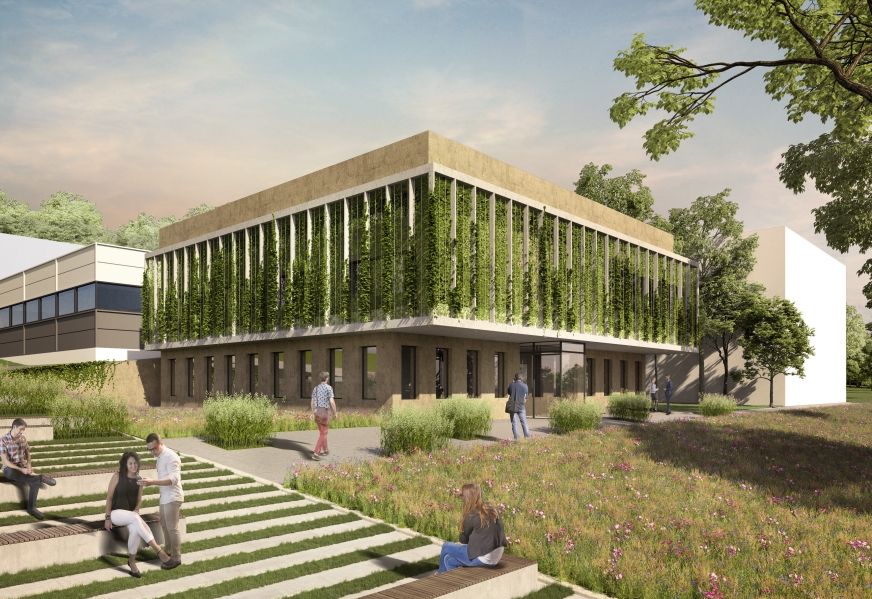
Plants are known to help break down harmful CO2. A bachelor's thesis at the Burgenland University of Applied Sciences focussed intensively on the topic of façade greening using the example of the Lowergetikum research building of Forschung Burgenland in Pinkafeld. The student's conclusion: Win - win for all involved. In addition to the low acquisition costs, the comprehensive benefits for people, buildings and the climate are also convincing.
Eisenstadt, 9 January 2024 - Buildings account for 40% of global energy consumption, mainly because they need to be heated and cooled. Both building insulation and the façade are crucial to reducing this energy consumption. UAS Burgenland student Manuel Cserer dealt with the latter in his bachelor's thesis on the Energy and Environmental Management degree programme. He assessed various options for greening buildings and, based on this, made a proposal for implementation at the Lowergetikum research building of Forschung Burgenland in Pinkafeld.
Cserer is continuing his studies on the Master's programme in Energy and Environmental Management at the UAS and would also like to deal with the topic in his Master's thesis. Thanks to his expertise, he has now been accepted into the professional association for greening buildings. This organisation is active in Germany, Austria and Switzerland.
The results summarised:
- Heat loss could be reduced by up to 10 % through extensive greening.
- The microclimate is also improved locally in the area of the building. Up to 85 % of dust particles can be filtered by green roofs.
- In contrast to greened buildings, ungreened buildings heat up to 80°C in the course of a summer's day.
- Facade greening can increase the relative humidity in summer by up to 40 %.
- The surface temperature can be reduced by up to 20°C.
- In winter, winter thermal insulation can increase the air temperature by 7°C.
- The protective function extends the service life of building components by up to 10 years.
- Façade and roof greening relieves the burden on the sewer system, as the plants can absorb a large proportion of the rainwater when it rains.
Manageable production costs
A basic distinction is made in façade greening between the extensive "light variant" with a plant structure of around 10 cm and intensive greening at a height of around 25 cm. The production costs for extensive green roofs amount to around €25/m². In contrast to extensive green roofs, the production of intensive green roofs is significantly more expensive. The cost of establishing a green roof is around € 50 - 100/m².
It is more cost-intensive indoors, as these are also technically more complex, says Cserer. "Apart from the fact that you have to strengthen the wall indoors so that it can bear the additional load, the water and electricity supply inside also presents us with greater challenges." However, the enormous stress-reducing effect of greenery indoors should be emphasised. According to current studies, the perception of stress is reduced by up to 50%.
Further research planned
"With the Lowergetikum, we are currently also planning to investigate outdoor greenery in research projects, as it also acts as a system on the façade and influences the entire building concept (heat and moisture). Several project applications are currently in the submission phase. A key point will be the coordination of the building technology with the planting, as this will vary from season to season. Other topics include automated care and the right choice of plants, as well as protecting the façade. There is certainly enough need for research," emphasises Marcus Keding, Managing Director of Forschung Burgenland.
More information on the Lowergetikum research building can be found at Lowergetikum - Forschung Burgenland (forschung-burgenland.at)
Further information:
Mag.a Christiane Staab
Marketing & Communication
Fachhochschule Burgenland GmbH
Tel: +43 (0)5 7705 3537
E-Mail: christiane.staab@hochschule-burgenland.at