How intelligent are octopuses?
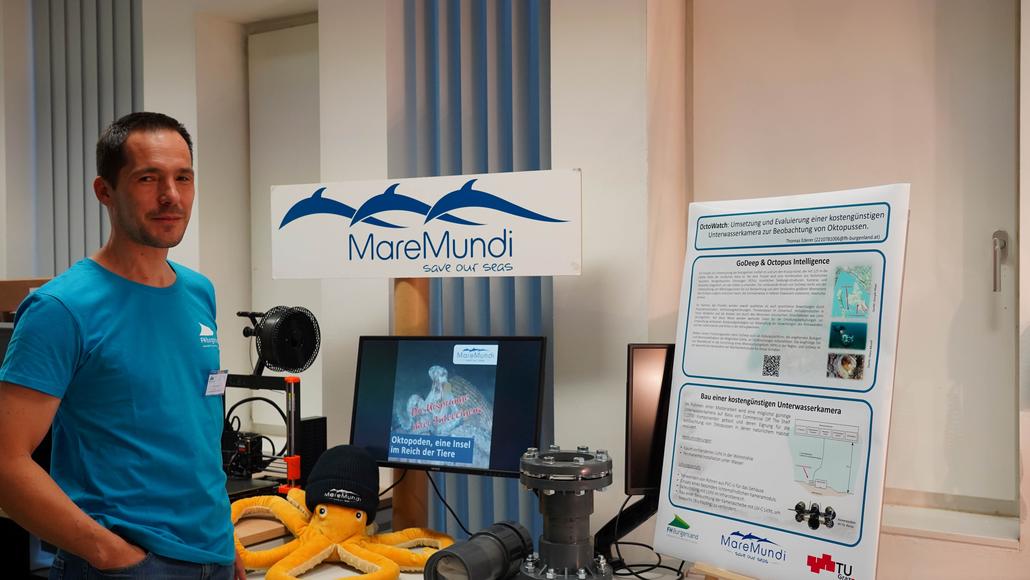
FH Burgenland student Thomas Ederer is working on an underwater camera that will benefit marine research.
Eisenstadt/Krk, 16 January 2024 - Octopuses are among the most fascinating animals in the world, not least because of their three hearts and nine brains, which can work independently of each other. They are also considered to be extremely intelligent and capable of problem-solving. However, the animals' habitat in the depths of the sea does not make it easy for researchers to collect sufficient data on the animals and their behaviour. Thomas Ederer, a student on the Cloud Computing Engineering Master's programme at Burgenland University of Applied Sciences, wants to remedy this situation. As part of his master's thesis, he is building an underwater camera that will benefit such research projects in the future. He is supporting the GoDeep initiative of the Austrian association MareMundi and is working with international experts, for example from Graz University of Technology, including on the island of Krk.
Cost-effective alternative for research
"Of course, there are already high-tech cameras on the market that can be used to film at great depths," explains Ederer. However, the cost of such a camera is 4,000 euros or more. An investment that few research initiatives can afford. As part of his Master's thesis, the student is now building an underwater camera based on so-called Commercial Off The Shelf (COTS) components that is as inexpensive as possible. Using the simplest materials, such as PVC wastewater pipes, he is tackling the challenges of filming at great depths.
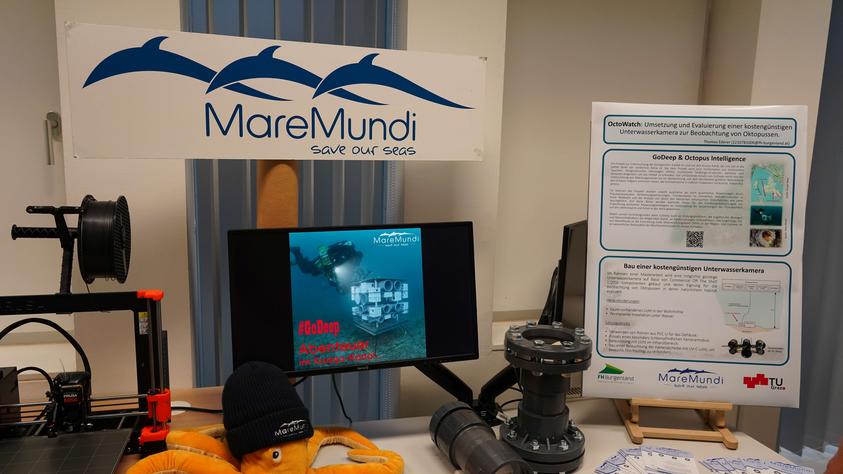
"In addition to the high water pressure, the main problems are the lack of light and the fact that the camera is to be used underwater for a long period of time, which leads to colonisation by microorganisms, plants and animals (bio-fouling). Without countermeasures, this fouling would quickly obscure the camera's view," says the student.
Thomas Ederer's Master's thesis is being supervised by Wolfgang Slany, Professor of Software Technology at Graz University of Technology, who is very interested in the life of octopuses both privately and in his research.
Camera tests on Krk and in Lake Neufeld
The innovative camera is currently being evaluated in Lake Neufelder in Burgenland, which is ideal for experimentation due to its depth of up to 24 metres. The complex final solution is intended to fulfil the purpose of being able to observe octopuses in their natural habitat. The aim is to provide scientists with more information about these fascinating animals. Ederer's installation will make an important contribution to this. In its final state, the camera will be able to illuminate the animals' habitat with infrared light and send the recorded data to the above-water unit via an optical fibre. An LTE module, a single-board computer, a network router, a photovoltaic system and a GPS module are installed there. The interaction of these components poses a particular challenge. He would like to make the building instructions and the results of his work available free of charge (open source) for future research projects.
Research as part of GoDeep & Octopus Intelligence
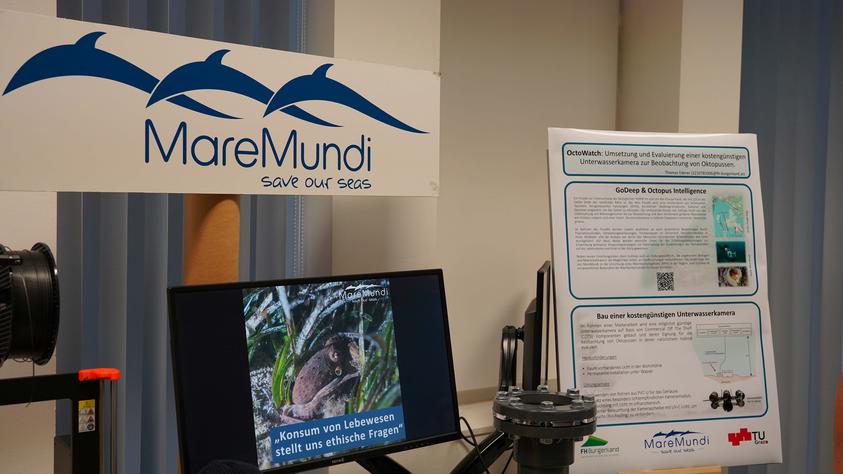
This is a project to study biodiversity in and around the Krusija Channel, which at 125 metres is the deepest point in the northern Adriatic. The project uses a combination of technical divers, remotely operated vehicles, artificial colonisation structures, cameras and sensors to explore the area. The comprehensive approach of GoDeep ranges from the study of microorganisms to the observation and understanding of larger marine animals such as Octopus vulgaris. Another important aspect of the research on these octopuses is also the better future protection of these fascinating creatures. In addition to its research objectives, GoDeep also serves as an educational platform that offers prospective biologists the opportunity to participate in field research. MareMundi's long-term goal is to establish a Marine Protected Area (MPA) in the region, and GoDeep is an integral part of the feasibility study for this endeavour. More about MareMundi. More about GoDeep.
Facts about the programme
Master's degree programme in Cloud Computing Engineering - Duration - 4 semesters, Academic degree - Master of Science in Engineering - MSc, Organisational form - part-time (usually every fortnight Friday 14:00 to 21:00 and Saturday 8:30 to 17:15), approx. 50% distance learning, No tuition fees, Place of study - Eisenstadt, Language of instruction - German (individual courses are held in English).
Enrolment is already possible online. Information at www.fh-burgenland.at or the InfoLine 05 7705 3500.
Further information:
Mag.a Christiane Staab
Marketing & Communication
Fachhochschule Burgenland GmbH
Tel: +43 (0)5 7705 3537
E-Mail: christiane.staab@hochschule-burgenland.at
# Gepostet in: