The technology has many advantages, but there is still research to be done before the fuel cell can be used optimally.
Nora Kirchknopf, graduate of the FH Burgenland and researcher
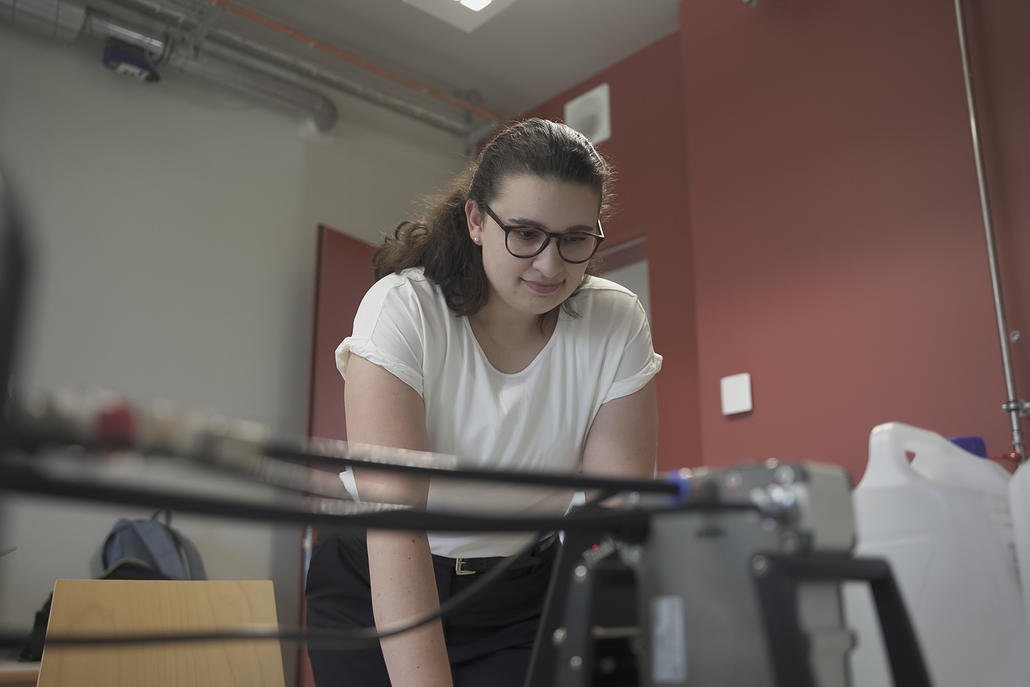
Nora Kirchknopf chose an exciting and, above all, promising topic for her Master's thesis in Building Technology and Facility Management. She wants to continue working on the topic of fuel cells.
Eisenstadt, 03.10.2023 - Hardly anything in our modern lives works without electricity. In this context, we are currently facing two major challenges: firstly, the security of our electricity supply and the possibility of storing electricity temporarily - keyword blackout - and secondly, the sustainable provision of electricity - keyword reduction of CO2 emissions. A high-temperature fuel cell can generate electricity and heat independently of the electricity grid and can be operated with both conventional and alternative fuels.
The technology has many advantages, but there is still research to be done before the fuel cell can be used optimally.
Nora Kirchknopf, graduate of the FH Burgenland and researcher
Nora Kirchknopf works at Forschung Burgenland and dedicated her master's thesis from the Building Technology and Facility Management degree programme to the future of fuel cells.
Burgenland has ideal conditions for the use of renewable energy sources. But the sun doesn't shine when I turn on the dishwasher in the evening and wind energy is not always enough to charge my e-car. "To compensate for the volatility of renewable energy sources, short- and long-term storage becomes necessary," Kirchknopf explains.
"Besides conventional batteries, electrochemical storage based on power-to-gas technologies is gaining more and more attention. Electrolysers and, in the future, reversible fuel cells enable the conversion and storage of electrical energy in the form of hydrogen. If required, the stored hydrogen can be used again to recover electricity and the waste heat can be utilised. The technology requires no rare raw materials and is also very scalable. These are significant advantages that promise great market potential."
In the course of the SOFC5-60 project of Forschung Burgenland, the student was commissioned to integrate a prototype of a "Solid Oxide Fuel Cell" (SOFC) developed by project partners into the laboratory of the University of Applied Sciences Burgenland. A follow-up project is already being worked on. "We are currently building a test stand for a reversible fuel cell. The goal is to produce hydrogen from surplus electricity, e.g. from a PV system. In fuel cell mode, this hydrogen can then be converted back into electricity."
That in itself is not a world first, the researcher admits. "But such fuel cells are not available off the shelf." Overall, fuel cell research is striving to make this technology more reliable, efficient, cost-effective and environmentally friendly to enable its wider use in various fields. So, she says, it is important to keep up with the scientific work on the subject. Her experience and recommendations for action will benefit further research in the subject area.
Research topics Kirchknopf dealt with were the integration of the fuel cell into a building, the integration into the building management system, the safety aspects to be considered, the commissioning and the operation of the fuel cell system. The expert will continue to stay on the subject.
The FH Burgenland currently offers 13 Bachelor's, 13 Master's and two PhD programmes at two study centres in Eisenstadt and Pinkafeld. Currently, well over 7,700 regular and associate students are studying in five departments, namely Business, Information Technology, Social Affairs, Energy & Environment and Health, as well as in continuing education courses.
Enquiries:
Mag.a Christiane Staab
Marketing & Communication
University of Applied Sciences Burgenland GmbH
Tel: +43 (0)5 7705 3537
E-Mail: christiane.staab@hochschule-burgenland.at
# Gepostet in: