


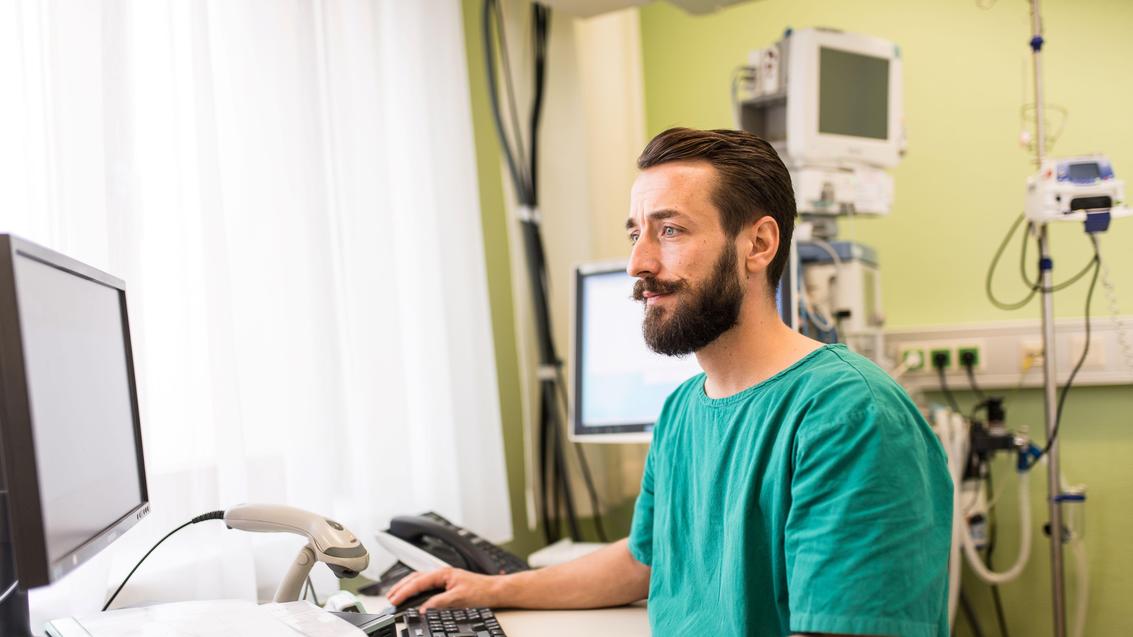
I wanted to further my personal education. My aim is to understand the Austrian healthcare system and find my way around it better.
Markus Leich, Student
You can find profiles of notable graduates, students, lecturers and staff from this degree programme, along with their stories, here and on our blog.

He is studying for a Master's degree in Health Management and Integrated Care at Burgenland University of Applied Sciences and is already in his final semester.
His path to studying midwifery was not straightforward. After more than a decade in the catering industry, including at the famous Steirereck, he sought new challenges as a centre manager in the serviced property sector and office manager in a management consultancy. He wouldn't want to miss any of these professional positions, as they have shaped him and given him valuable insights into different working methods and diverse requirements. Ultimately, however, he realised that he lacked direct contact with people - a need that ultimately led him to study midwifery.
A friend recommended that he study to become a midwife. He did some research, took the entrance test and was accepted. "It's something special when you can be there at the start of life and also accompany the family. I provide support during labour, pregnancy and the postnatal period. It's fulfilling, but also very demanding," says Markus. The staffing situation is very difficult, he says. There is a shortage of skilled personnel everywhere. Although the number of training places has already been increased, the conditions in the world of work are changing. Very few midwives want to work 40 hours on a permanent basis because they also want to work part-time - but there is a broad spectrum. The centrepiece is childbirth. However, midwives also want to work in other areas. This is only possible on a part-time basis. "There needs to be a rethink. Employees want to be more flexible, new working time models are needed," he emphasises.
Markus has worked at Klinik Donaustadt from the very beginning and is very happy there. Here, the focus is very much on spontaneous vaginal birth, even in the case of a twin pregnancy or breech position- all under high medical standards.
Why did he decide to apply for a Master's programme at Burgenland University of Applied Sciences?
I wanted to further my personal education. My aim is to understand the Austrian healthcare system and find my way around it better.
Markus Leich, Student
He can definitely imagine a management position and also has the desire to teach.
He is now almost finished with his Master's programme and has nothing but good things to say about it.
"I really enjoyed the programme, especially the close exchange between theory and practice. Thanks to the comprehensive wealth of knowledge and practical experience of the many dedicated lecturers, we students were not only able to acquire in-depth specialist knowledge, but also learn how to apply it in practice. The direct insight into real-life situations provided by external lecturers and the joint discussion of specific cases have significantly deepened my understanding of complex interrelationships."
When asked how he found his way as a man in a professional field dominated by women, Markus reports that the degree programme was particularly challenging. "As a man, you're often the centre of attention in this field. Existing stereotypes don't always make it easy. Nevertheless, I was able to dispel many prejudices through openness and commitment."
Gender plays no role in his professional practice. In a public hospital, equality is a top priority - regardless of the gender of the carer. The focus is always on client-centred, scientifically sound and empathetic care.
Thanks to his professional expertise and respectful treatment of clients, initial uncertainties are quickly dispelled, so that trust and professional cooperation take centre stage.
What particularly fulfils him about his profession: "Midwives are highly qualified specialists with a scientifically sound education, which they acquire through their studies. Their profession is regulated by law, which allows them to work autonomously and independently. As the first point of contact during pregnancy, labour and the postnatal period, midwives provide women and families with comprehensive and empathetic support.
In addition to medical care, social and emotional support also plays a central role. Midwives are particularly sensitised to the individual needs of women and their families. The close and trusting support creates a protected space in which both medical and family concerns are taken into account."
Images ©Andrew Rinkhy Photography
# Gepostet in:
Besondere Stories,
Alumni Stories,
Masterstudiengang Gesundheitsmanagement & Integrierte Versorgung


