

I still live this bond.
Christoph Urschler, FH Lektor and member of the management of TBH Ingenieur GmbH

I admit that I seem to have had certain prejudices against technicians. Even at school, languages were more my thing than maths, not to mention technology. For a blog post about our Master's degree programme in Building Technology and Facility Management, I was able to speak to eight top managers in the building technology sector and learned (at least) three things about technicians:
Thanks to the great network of programme director Christian Heschl and his team, my interview partners were happy to be at our disposal - thank you very much for your time, your commitment to FH Burgenland and your dedication to a better world.
As already mentioned, the Master's degree programme in Building Services Engineering and Facility Management is something of a flagship programme at FH Burgenland. It has been running at the Pinkafeld campus for a very long time.
The degree programme is no walk in the park and demands a lot from the students. This makes the team spirit all the greater - and this extends far beyond the degree programme.
Pinkafeld is known throughout Austria as a centre of excellence for building technology. Graduates are in demand on the labour market. Companies use the expertise from the degree programme for their innovation projects.
I asked eight well-known managers from Austria, all of whom studied at the Burgenland University of Applied Sciences, about their fascination with building services engineering, their own career paths and why alumni of the Burgenland University of Applied Sciences are in such demand on the labour market.


I still live this bond.
Christoph Urschler, FH Lektor and member of the management of TBH Ingenieur GmbH
He completed his degree in building technology and facility management in Pinkafeld 20 years ago and the field is still not just a profession for him, but a vocation.
Friendships for life have developed for him during his studies. In addition, professional research and development projects connect him with the degree programmes at the UAS. In close coordination with programme director Christian Heschl, TBH Ingenieur GmbH, of which Urschler is a member of the managing directors' team, is currently planning a new research laboratory at the UAS campus in Eisenstadt.
The company (TBH Ingenieur GmbH) specialises in building and energy technology. "We calculate heating requirements, cooling loads, we put things out to tender, represent the client - we plan their technology and are strongly in favour of implementing renewable energy systems. Our customers are residential property developers, trade and industry. We also do a lot of R&D work - partly for our customers and partly for ourselves, because we want to bring innovations and new ideas into our company," says Urschler.
He discovered his affinity for technology as a teenager. "I was generally fascinated by technical processes." When he chose his degree programme, the desire to make a difference and do what he could to preserve the health of the planet for generations arose. He describes his degree programme as a rock-solid education in building technology.
This is how he describes why graduates are so much in demand in the industry:
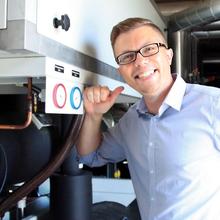
Strong specialisation is required. This is optimally realised through the degree programme. Above all, students are also taught important foresight and the interrelationship of systems. The degree programme in Pinkafeld is definitely one of the best training courses that will continue to be in great demand in the future.
You always meet twice in life, as the old saying goes. "In our industry, it's more like 15 to 20 times," says FH Burgenland graduate and Allplan Managing Director Georg Brandauer with a twinkle in his eye.

Austria is small, the industry is manageable and graduates of the Burgenland University of Applied Sciences can be found all over the place.
Georg Brandauer, editor and Allplan managing director
He has now been a lecturer on his former Building Technology and Facility Management degree programme for more than 10 years. "What impresses me about teaching is that you can meet young, dynamic people who will be successful in the future, get to know the young people's point of view and contribute to the practical relevance of the degree programme."
What the alumni of FH Burgenland, which enjoys an excellent reputation as Austria's centre of excellence for building technology, bring to the table: "They are very well trained in innovative technologies. They have the necessary theoretical depth, but also the necessary practice-orientated breadth." Brandauer confirms that there is definitely a job guarantee.
Brandauer experienced first-hand just how challenging studying in Pinkafeld can be. "The course director at the time swore us to the code of honour," he recalls. "The degree programme wasn't easy, but we weren't left alone by the teaching staff. There is a special community between lecturers, students and alumni."
Allplan has been involved in energy and environmental technology for over 50 years. Brandauer is one of three managing directors and is primarily responsible for building technology and building physics. "The big issues for us are climate neutrality, resource-saving work and planning. We plan all types of buildings - around 150 to 200 projects at a time - from very small to very large. We also have our own team for hospital technology." Projects have included Mistelbach LKH, Wien Mitte, the Austria Campus in Vienna and many more.
"We don't do it for the sake of the technology, but for the future users of the building, for their comfort. I imagine that whoever lives or works in this building should have the right temperature, the right lighting conditions and sufficient fresh air... That's our responsibility."
Josef Gamperl, Managing Director of the engineering firm ZFG-Projekt, was actually born into a different profession. "I come from a family of farmers and therefore trained in agriculture." Gamperl took over his parents' business - but only on a part-time basis. His vision was to study building technology at the University of Applied Sciences Burgenland in Pinkafeld, which a friend had told him about. "The path to studying was not easy. I didn't have a school-leaving certificate and had to convince my parents first," he says looking back.
He started as a trainee at ZFG-Projekt. Since 2017, he has been one of the managing directors and ZFG-Projekt is the largest planning office for technical building services in Austria with 110 employees and three locations.
My path in the company was a classic one and I can only advise all young people: you need patience at the beginning of your career. It takes three to four years before you can manage projects yourself.
Josef Gamperl, Managing Director ZFG Project
"It is and remains exciting to see what you do. It's the same in agriculture and in my job. There's the theoretical part, the thinking about realisation, the putting it on paper. And then someone actually builds it in the form you had in mind. It's an absolutely fantastic experience."
He is still very attached to FH Burgenland.
The training is absolutely in line with market requirements. Accordingly, the battle for alumni in the industry is relatively fierce. This is one of the reasons why we seek close contact with the university in order to establish a relationship with people even before they graduate. We are particularly pleased that we are currently helping to plan the new FH location in Pinkafeld.
FH graduate Klaus Szep is an authorised signatory and head of department at pde Integrale Planung GmbH, the planning subsidiary of the PORR Group. "We deal with all specialist areas of sustainable building construction planning and apply innovative methods such as Building Information Modelling and LEAN Design," he explains. "This means that we plan and coordinate all the trades required to construct a building." This includes not only traditional building services engineering, but also architecture, structural design and specialised topics such as building physics, fire protection and building certifications.
Around 80 specialist planners work in his department alone.
What I find particularly attractive is that there are always new challenges. We are very interested in our further development and strive for challenging and technologically demanding projects. What our customers appreciate most is that we provide them with holistic advice with our operational construction expertise in the background and can therefore respond flexibly to their project.
As a graduate of the HTL Pinkafeld, studying building technology and building management at the FH Burgenland was an obvious choice for Szep. "What is taught and dealt with there is still extremely promising for the future," he is convinced. 20 years of professional experience later - including 10 years in an international context - he knows two things for sure:

Firstly, the importance of the topic continues to grow! In many projects, technical building equipment has already overtaken the traditional building trades in terms of investment volume. The most important factor in whether a project is a success is usually decided in the MEP - because ultimately the MEP is largely responsible for whether a building works or not.
Secondly, I went abroad straight after university and worked in the Middle East, Eastern Europe and Switzerland for around 10 years. This experience showed me that we have nothing to hide with our education. Graduates of Burgenland University of Applied Sciences are very well equipped and can apply their expertise and work successfully anywhere.
Klaus Szep, authorised signatory and head of department at pde Integrale Planung GmbH, the planning subsidiary of the PORR Group
This is another reason why alumni of his former degree programme are very welcome as employees at pde. "With this training, you are extremely broadly positioned. You have a better focus across the entire project - you are the generalist among all the professionals," Szep is convinced.
PORR and FH Burgenland are also keen to work together on innovation. "We discussed digitalisation in building technology with the people in charge at the UAS years ago. As a company, we also jumped on this future topic very early on."
Michael Haugeneder is Managing Director of ATP sustain GmbH and describes his job as extremely varied: "We support sustainable construction projects. This means that we work out the ecological, economic and socio-cultural aspects of a building together with the client." These are medium and large construction projects, mainly buildings from 5,000 m2 and larger up to city districts or neighbourhoods.

What I find exciting about my job is that we have the opportunity to help create a better future. This is because we can work on key aspects of projects at a very early stage, such as CO2 neutrality, affordable housing and living, comfort, human and environmental health. Our aim is to create buildings whose quality brings significant added value to society.
Michael Haugeneder, Managing Director of ATP sustain GmbH
Even as an HTL student, he was already interested in wood as a building material and recycling. But the topic of energy has also stayed with him. "Everything is energy," is still his motto - "even every solid material is made up of energy."
At the Burgenland University of Applied Sciences, he found exactly the topics he was looking for in the Building Technology degree programme. Even after many years, he remains loyal to his old university. He teaches as an external lecturer in the field of sustainable construction and safety & security and, as an employer, is always happy to take on graduates of his former degree programme.
These people have a lot of basic knowledge of thermodynamics or fluid mechanics, for example. Innovative developments can only be driven forward by those who understand physics. The basics are very important and must not be lost," he appeals. "If you don't understand the basics, you can't judge new technologies.
"Everyone is talking about EU taxonomy or the Green Deal. In order to realise the EU's vision, we need technical guidelines for actual implementation in all sectors. The good thing is that the EU directive is based in the financial world. This may not have anything to do with the construction industry directly, but every banker who has to deal with it needs a technician to provide support. In the future, we will need experts who can answer these important questions. The financial world is the biggest driver in the economic system and therefore the strongest lever for changing the economic system towards eco-social reform," Haugeneder is convinced.
Future questions will revolve around how a building can be constructed in a climate-neutral way and withstand climate change. Students at FH Burgenland are learning what is needed for this. "Alumni of the Master's degree programme in Building Technology and Facility Management are admitted to write expert reports here. This will be a key asset in the future. Experts with a university degree will have their hands full in the coming years - more than ever," predicts the expert.
Peter Weinzettl realised that he wanted to study Building Technology and Facility Management at the Burgenland University of Applied Sciences as soon as he finished his A-levels. He graduated in 2000 and immediately gained a professional foothold in a planning office. "I was quickly given the opportunity to work on very interesting projects and was thrown in at the deep end. That can be very refreshing for a professional career," he says humorously today. This gave him the opportunity to be part of great projects at a very young age. From the Uniqa Tower to the Design Tower on Vienna's Schwedenplatz, where he was responsible for the energy concept.
After intensive years working mainly in Austria, he was drawn back to southern Burgenland. For this reason, he passed the civil engineering examination in 2007, for which FH graduates have been authorised since 2006. An important step for him to gain a foothold in Burgenland. At this time, Woschitz Engineering was planning to include the Energy Design area of expertise - an opportunity for Peter Weinzettl.
His projects are multi-layered and interdisciplinary, he describes.

It is important to us to think outside the box. We propose and realise highly innovative concepts.
Peter Weinzettl , Managing Partner Woschitz Engineering
In 2010, he founded the Energy Design department at Woschitz Engineering and has been a managing partner since 2012. He and his colleagues recognised early on that digitalisation would become a very important topic in the industry.
Digitalisation opens up unimagined opportunities for employees - no matter where they are based - to do their job superbly. Things are going really well for us. We even took on people during the crisis.
He also paints a promising future scenario for the graduates of his former degree programme: "Energy and environmental engineers have nothing to fear. A major revolution is imminent and we will have to tackle the energy transition more consistently."
According to Weinzettl, the industry is currently facing a radical change. BIM (Building Information Modelling) planning is becoming extremely important. "This can only succeed if there is a serious rethink of building culture - especially in German-speaking countries. The entire building culture must change, away from the lowest bidder principle and towards appropriate budgeting for high-quality projects. There also needs to be a rethink on the investor side, because digitalisation brings long-term added value." Here too, he sees a lot of potential in the younger generation, namely in a different approach to certain topics.
He can definitely recommend the industry: "You have to juggle a lot of balls at the same time, appreciative interaction with people is important, as are technical skills or legal expertise and commercial thinking. That's why it remains very interesting."
Simon Handler, who studied civil engineering and building technology, has a doctorate in the overlapping field of construction and building technology and is an expert in the integral development of energy and building concepts. He is the managing director of hacon GmbH in Eisenstadt.
He studied civil engineering at Graz University of Technology and Vienna University of Technology. "After graduating, I started working in the field of building physics and only came to building technology through my job," he explains. "I very quickly realised that I was completely missing the building services for a holistic view of the topic of 'energy in buildings'."
During his doctorate on the subject of component activation, he decided to specialise further in the field of building technology. Parallel to his doctorate, he studied for a Master's degree in Building Technology and Building Management at the University of Applied Sciences Burgenland in Pinkafeld and describes this time in retrospect as a "pretty ambitious phase of his life."

In my case, the decision to go to the UAS and specialise in building services engineering was worth its weight in gold, as was the decision to do a doctorate!
Simon Handler, Managing Director hacon GmbH
He has been self-employed with his planning office hacon since 2020. "Our customers are primarily property developers or general planners and building services planners," he explains. His company is the number one contact for building physics.
"With the help of modern simulation technology, we create realistic images of our buildings and thus enable cost-efficient dimensioning of the building services systems. This often plays a decisive role, particularly in the field of geothermal energy."
It was nice not to be a number. The training programme helped me progress in the field in which I work, because we dealt a lot with innovative planning methods.
Thomas Schlögl is an authorised signatory and office manager at the Hartberg site of Lechner und Partner Ingenieure GmbH. Technology has always played a role in his life, and an HTL education in Pinkafeld was an obvious choice. However, his entry into the Bachelor's degree programme in Energy and Environmental Management at the Burgenland University of Applied Sciences was unusual. "We were given the opportunity to start the degree programme during our military service, which saved us a year," he explains.
He followed the bachelor's degree programme with a master's degree in Building Technology and Facility Management and completed the qualifying examination for engineering offices at the same time. This was followed by further qualifying examinations up until 2017, when he passed the civil engineering examination. This is only possible after completing a Master's degree in combination with professional experience and other certificates. Since 2018, he has held the qualification as an engineering consultant for building services engineering and facility management assigned to his specific degree programme.
He started as a technician in a planning office in 2009. "We were two people in a container - it grew step by step," he looks back. His project planning always focussed on building services. However, similar to the development of the degree programme in Pinkafeld, his portfolio also expanded into the field of building automation.
The company has grown and now employs 40 people in Hartberg and Vienna. Thomas Schlögl has been Managing Director since 2019 and an authorised signatory and office manager for the Hartberg site since 2020. Of the technicians in his team, five graduates and five students are currently employed.
He also thinks the part-time model at FH Burgenland is great from an employer's perspective:

Studying, academic work and putting what you have learnt into practice professionally is what characterises this phase of life for students. It's not everyone's cup of tea to sacrifice five years of weekends to their studies, but it definitely pays off. As an employer, we very much encourage our employees to study.
Thomas Schlögl , authorised signatory and office manager of the Hartberg office of Lechner und Partner Ingenieure GmbH
Thomas Schlögl himself has been an external lecturer at his old university since 2019 - and not without "ulterior motives".
Teaching gives me the opportunity to get to know the next generation. I deliberately want to keep the connection to the UAS very strong. It's a great community.
Why should young people choose this particular subject area? We probably have one of the most extensive specialisms in technical building services. The subject allows for a great deal of individualism and has a practical orientation throughout.
You can study these exciting topics at the UAS Burgenland in the Department of Energy & Environment. Dealing with future topics in this field is definitely worthwhile!
# Gepostet in:
Bachelorstudiengang Gebäudetechnik und Gebäudeautomation,
Bachelorstudiengang Energie- und Umweltmanagement,
Masterstudiengang Gebäudetechnik und Gebäudemanagement,
Energie-Umweltmanagement


