

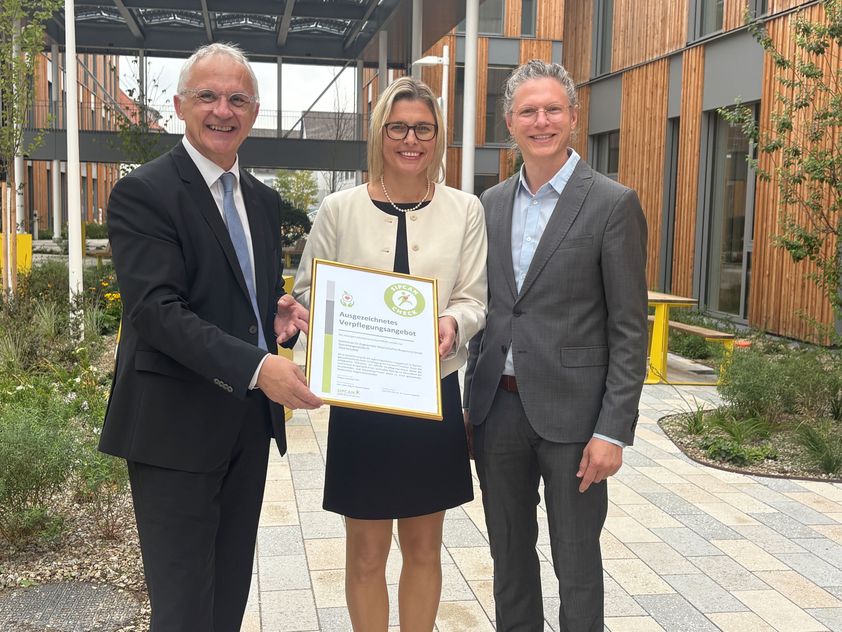
Austria’s first university to be certified for healthy catering.

©#viewitlikejenni, edited using AI
Pinkafeld, 20 October 2026. The University of Applied Sciences Burgenland is the first higher education institution in Austria to have designed all catering facilities on its new Pinkafeld campus in accordance with scientific criteria to promote health, and to have had this verified by an external specialist organisation. The certification process was initiated by nutritionist Barbara Kramer-Meltsch, a lecturer in the Department of Health & Social Sciences. Over a period of several months, the framework conditions for certification were reviewed in collaboration with the catering operator Gästehäuser und Küchen Burgenland GmbH and the team of experts from SIPCAN. Menus and product ranges were analysed, assessed and adapted in line with the specifications.
An ‘Excellent Catering Service’ all round
In addition to the canteen with its hot meals, the SIPCAN certification also covers the break-time refreshments, the snack vending machines and the drinks vending machines. Factors taken into account included the selection and composition of the lunch dishes, the sugar content of the drinks, the range of light meals on offer and the selection of snacks in the vending machines. The final audit by SIPCAN found that all four areas met the specified criteria and thus also the requirements for the ‘Excellent Catering’ certification.
With this award, the Pinkafeld Campus is taking on a pioneering role in Austrian university catering. It demonstrates how a comprehensive catering concept can be implemented in everyday university life in a way that promotes health. This benefits around 1,000 students on campus as well as the university’s staff – and, in future, all subsequent cohorts of students.
Some key requirements for certification are as follows:
Lunch:
Vegetarian savoury main courses must be offered on at least nine out of ten days. Sweet main courses may be offered on no more than one day out of ten.
Drinks vending machines:
At least 80 per cent of the drinks on offer must contain no more than 6.3 g of sugar per 100 ml and contain no sweeteners. Mineral water must be a permanent feature of the range.
Snack vending machines:
Dairy products and vegetarian products are a permanent feature of the range. Sweets, pastries and savoury snacks make up no more than a third of the total range.
Break-time sales:
At least 50 per cent of the baked goods on offer contain a high proportion of wholemeal or whole grains. More than half of the pastries are offered with savoury vegetarian toppings.
Transferring research and teaching into campus catering
The University of Applied Sciences Burgenland has placed a strong focus on promoting the health of staff and students for decades. Accordingly, those in charge are delighted to now be taking on a pioneering role across Austria. “In the Department of Health & Social Sciences, teaching also focuses on nutrition-based health promotion. We are delighted that our canteen is now putting these principles into practice in everyday campus life and that we have been recognised for this by the SIPCAN Institute for Preventive Medicine,” emphasises Barbara Kramer-Meltsch.
Manuel Schätzer, nutritionist and project manager at SIPCAN: “Health-promoting catering is particularly successful when the focus is not just on individual products, but on the entire range on offer. At the Pinkafeld campus, this comprehensive approach has been consistently implemented – from lunch in the canteen to the drinks vending machines. As a result, the healthier choice really does become the easier choice for students in their day-to-day lives.”
About SIPCAN
SIPCAN is a non-profit, independent institute for health promotion and prevention based in Salzburg. The name stands for ‘Special Institute for Preventive Cardiology And Nutrition’. The focus is on the prevention of diet- and lifestyle-related diseases such as cardiovascular disease, diabetes and obesity. SIPCAN advises and supports businesses, catering organisations, schools, nurseries and local authorities in designing food provision and living environments that promote health. To this end, SIPCAN uses scientifically sound criteria, the implementation of which is monitored and assessed. Further information: www.sipcan.at
About Burgenland University of Applied Sciences
The University of Applied Sciences Burgenland currently offers 32 Bachelor’s and Master’s degree programmes at two study centres in Eisenstadt and Pinkafeld. Currently, around 6,200 full-time and part-time students are enrolled across four departments – namely Energy & Environment, Health & Social Sciences, Information Technology and Business – as well as in university-level continuing professional development programmes. In 2023, Burgenland University of Applied Sciences celebrated its 30th anniversary and has more than 19,500 graduates. Further information is available at www.hochschule-burgenland.at
For further enquiries:
Mag.a Christiane Staab │ Marketing and Communications │ Burgenland University of Applied Sciences GmbH │ Tel: +43 (0)5 7705 3537 │ Email: christiane.staab(at)hochschule-burgenland.at
# Gepostet in:
News,
Presse,
Aktuelles


