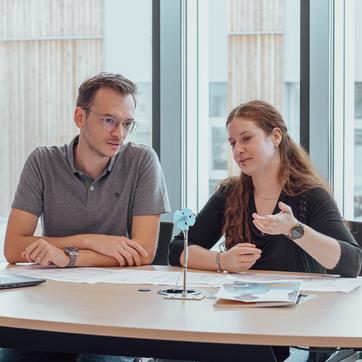
The Bachelor’s Degree Programme in Green Engineering combines solid engineering knowledge with targeted solutions for climate protection and global transformation. Going beyond theory, students learn how technical processes are structured and how to design them to be consistently sustainable.

The degree programme is aimed at aspiring professionals who want to develop practicable solutions regarding energy, materials and the circular economy, and so help to tackle pressing ecological challenges.

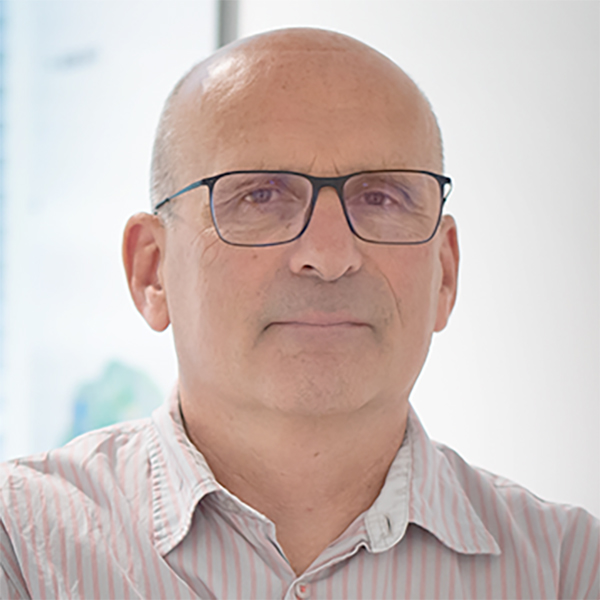
„In the Bachelor’s Degree Programme in Green Engineering, you learn to combine sustainability, technology and business. You develop renewable energy systems, design resource-efficient products, plan sustainable water management and think circular." 

Christian Wartha, Head of Department

Programme Fact File

Programme

Bachelor's Degree Programme - 6 semesters

Academic degree

Bachelor of Science in Engineering – BSc or B.Sc.

Programme structure

Full time

Study places

25

Study location

7423 Pinkafeld, Steinamangerstraße 21, Austria

Language

English (B2 level)

Tutition fees

None

English as the only language in the degree programme

Are you worried about studying in English? Even if you have not lived in an English-speaking country for any length of time before, you should feel confident to tackle the challenge. We expect English at Matura level (the Austrian final school-leaving examination) or B2 level when you apply and can assure you that your vocabulary and fluency will improve almost automatically during the six semesters. If you are still uncertain, you can attend additional English courses.

Online advisory sessions

Online advisory sessions for the new Bachelor’s degree programme in Green Engineering* (full-time, in Pinkafeld) with Head of Department Prof.(FH) DI Dr. Christian Wartha:

  • Tue, 10. November 2026, 17:00 – 17:30 
  • Thu, 14. January 2027, 17:00 – 17:30 
  • Tue, 2. March 2027, 17:00 – 17:30 
  • Tue, 23. March 2027, 17:00 – 17:30 

Registration

Please register at least one day before the event.

To study for a bachelor's degree at our organisation, you must meet one of the following requirements:

ADMISSION REUIREMENTS FOR INTERNATIONAL DEGREE SEEKING STUDENTS FROM THIRD-PARTY STATES

DETAILS ZUGANGSVORAUSSETZUNGEN BACHELOR GREEN ENGINEERING

Twenty-five applicants are admitted to the Bachelor’s degree programme in Green Engineering each year.

Applications submitted to the Bachelor’s degree programme in Green Engineering within the specified deadline will be considered as part of the admissions process for the coming academic year. Applications must be made via the online application system.

Applicants must provide evidence of their English language proficiency as part of their application. The language certificate must have been obtained from a recognised language examination body (e.g. IELTS, TOEFL, Cambridge, Oxford), demonstrate a level of at least B2, and must not be more than two years old.

If no recognised proof of English language proficiency is submitted with the application, an English test must be taken prior to the admissions interview. Applicants will be informed separately about this English test.

Application deadline for applicants with visa requirements

In English-language degree programmes, the application deadline for applicants with visa requirements is 15 March of the corresponding calendar year.

FURTHER ADMISSION REQUIREMENTS FOR THIRD COUNTRY CITIZENS REQUIRING A VISA TO ENTER AUSTRIA

For applicants with certificates from third countries (i.e. all countries except the member states of the EEA/EU and Switzerland) without EU visa facilitation agreements the application deadline for the study programme starting in September ends on 15 March of the same year. This should give you sufficient time to apply for the required residence permit and/or visa and to obtain any missing documents and certifications.

Admissions Interview

To take part in the admissions process, you must meet all the entry requirements within the specified deadline. A preliminary selection will be made based on the documents you submit, which will determine whether you are invited to the admissions interview. During this interview, which will be conducted in English, we aim to get to know you, your skills and your qualities by discussing your education, additional qualifications and your motivation.

To be successful in your application, you must demonstrate sufficient proficiency in English (at least level B2).

Deposit

After the binding allocation of a place, University of Applied Sciences Burgenland collects a deposit of € 350 from students to secure their place. This deposit is refunded to active students after the end of the first semester. If an applicant does not fulfil the admission requirements before the start of the programme (e.g. did not pass the resit of the school-leaving examination, did not pass the additional qualification examination, etc.), the deposit is also refunded. In all other cases, the deposit is forfeited.

Highlights

  • Problem-based learning (PBL):
    Instead of relying on traditional lectures alone, the degree programme is based on student-centred teaching. Students work in teams to solve real, complex problems from engineering practice, while lecturers act as coaches.
  • Genuine interdisciplinary practical projects:
    In the modules of the fourth and fifth semesters, students work on concrete transformation projects directly with companies, NGOs or municipalities (e.g. municipal energy spatial planning or industrial decarbonisation).
  • Extensive professional internship:
    A compulsory subject-related 12-week internship in the sixth semester (in Austria or abroad) provides a direct route into the world of work.
  • Research infrastructure & living lab in Pinkafeld:
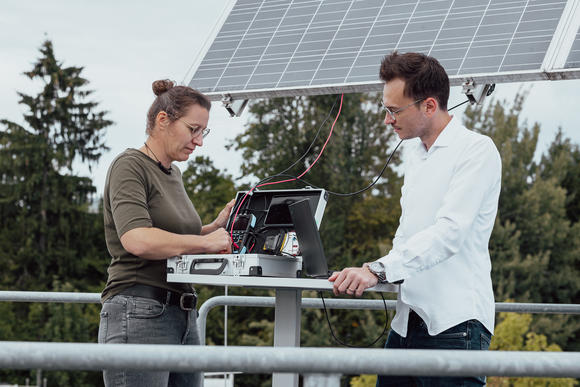
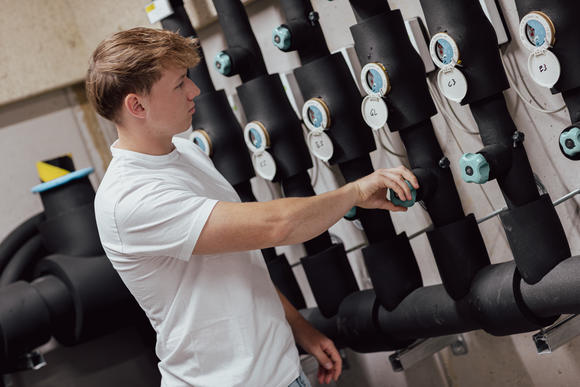
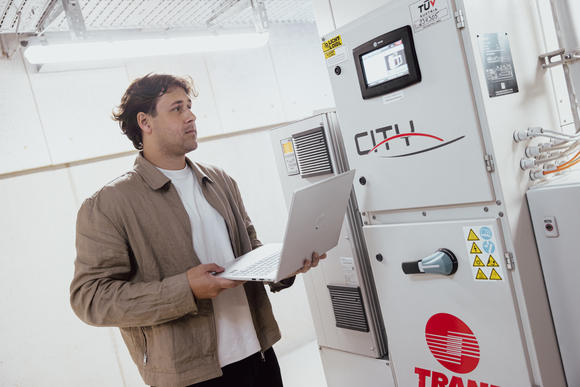
    The state-of-the-art campus in Pinkafeld, completed in 2026, is supplied entirely from renewable energy sources (the largest geothermal project in Burgenland). Students use high-tech laboratories such as the Energetikum (a genuine two-storey test building), the eco-friendly Lowergetikum and cutting-edge test facilities (e.g. for biomass, pyrolysis, fuel cells and hydrogen).
  • Strong corporate network:
    By the start of the degree programme, more than 30 partner companies have already provided declarations of cooperation, making it easier for students to access internships and jobs.

Career Opportunities

Graduates work at the intersection of technology, ecology and business. They typically find jobs in:

  • Renewable energy & decarbonisation

    Designing, dimensioning and integrating sustainable energy systems, as well as developing decarbonisation concepts for energy-intensive industries (such as steel, cement and chemistry).

  • Water & resource management

    Planning water and wastewater treatment plants, industrial water cycles and rain water management systems.

  • Sustainable process engineering

    Developing resource-efficient production processes in the interest of lean and green manufacturing.

  • Digitalisation & green tech

    Using simulation tools, artificial intelligence and digital twins to optimise energy and material flows.

  • Circular economy & life cycle engineering

    Developing circular products (ecodesign), planning recycling systems and optimising product life cycles.

  • ESG & sustainability management

    Managing and implementing sustainability strategies in companies to comply with current regulatory frameworks.


* subject to accreditation by AQ Austria